17 Simple Ways to Save More, Invest Smarter, and Stress Less
Chapters
0:0 Introduction0:30 Quick Episode Overview
1:22 How to Select Your Insurance Plan
5:19 Saving with a High Deductible Health Plan
14:19 Tips for Specific Drugs and Providers
15:27 Dental and Vision Plans
17:17 Benefits of FSAs
19:10 Getting Health Insurance Outside of an Employer
21:8 Getting Insurance for Your Business
23:20 Insurance via Medical Research Companies and Affinity Groups
24:52 Direct Primary Care
25:48 Reimbursing Medical Expenses Charged on a Credit Card
30:45 Diversification in an Incredibly High Stock Market
36:20 Investing in Precious Metals: Gold & Silver
40:55 Strategy for Handling RSU Compensation
43:35 Variable Universal Life Policy
48:5 The Rise in Auto Insurance Premiums Following an Accident
55:22 Buying A Used vs. New Car
58:6 Chris's Favorite Work Tools Including AI
62:7 Is AI an Actual Threat to Our Jobs?
64:26 Chris's Pre and Post W2 Job Experience
66:50 Find the Best Deals on the ATH Newsletter
70:53 The Next Gift Card Sale
00:00:00.000 | If you're interested in building an investment portfolio, making the right choices during open
00:00:04.400 | enrollment or AI tools, then you'll love this episode because I'm tackling 17 different great
00:00:09.840 | listener questions you all sent in, which also includes topics like buying gold, managing RSUs,
00:00:15.480 | life insurance, dealing with insurance premiums after an accident. There are timestamps in the
00:00:20.200 | show notes, so if you want to find something specific or come back to it later, you can
00:00:24.340 | absolutely do that. And if you want to keep upgrading your money points in life, click follow
00:00:28.820 | or subscribe. Okay, before I jump in, first off, thank you so much to everyone who sent
00:00:34.720 | in all the questions I'm going to cover today. There were way more than we'll get to in this
00:00:38.840 | episode, so I divided them up into a few different categories, and I'm going to try to tackle them
00:00:43.760 | regularly in episodes like this. So if you have other questions, please keep them coming. You
00:00:48.560 | can submit questions to us by going to allthehacks.com slash AMA, and that way they're ready for us when
00:00:54.880 | we prep the next episode. So the first question I want to tackle is very relevant to this time
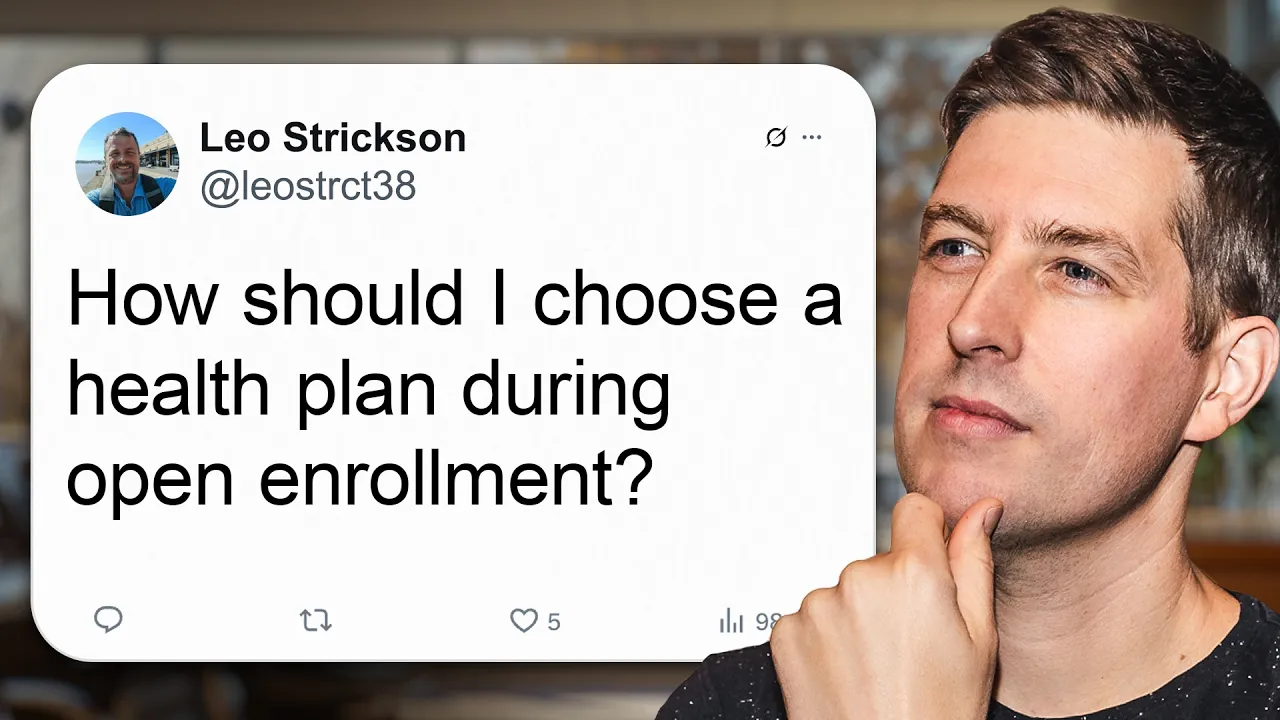
00:01:00.000 | of year, and that is how I'm thinking about open enrollment, especially when it comes to health
00:01:04.480 | insurance. So first off, if you go back to episode 140, which was a couple years ago, I did a really
00:01:09.940 | deep dive on open enrollment and a lot of my thoughts. So today, I'll kind of cover a high-level
00:01:15.360 | version of that and some of the things that have changed. But if you want to go even deeper,
00:01:19.560 | I definitely recommend going to give that episode a listen. So first off, my personal situation is
00:01:24.680 | that when my wife left her job at Wealthfront, we went on Cobra. So we have insurance through
00:01:30.260 | Wealthfront. After 18 months, Cobra runs out. Fortunately, in California, there's a program
00:01:34.820 | called CalCobra that can extend that for another 18 months. But at the end of those 36 months,
00:01:39.920 | you've got to figure it out on your own. And so we are coming up on that moment of having to do that.
00:01:45.280 | So first, I'm going to talk about plan selection, which is relevant to almost everyone that's
00:01:51.240 | thinking about this. But then I'll talk about what I've learned when it comes to actually shopping
00:01:55.780 | for policies, which if you work at a company and they offer health plans, isn't as relevant as the
00:02:00.820 | first section, but might be kind of interesting because I was really surprised with everything
00:02:05.000 | I've learned. But going back to how do I think about plan selection? I have evolved my take on this
00:02:10.640 | quite a few times in my career. I used to always go for the best platinum PPO, trying to get the best
00:02:18.300 | deal I could. And that was what I wanted, the best health insurance. And if you're working at a company
00:02:22.300 | where every single plan you choose is the exact same price, no matter how much it costs the employer,
00:02:28.020 | that might be the path to take. But there are a few things that I've experienced over the years that
00:02:34.120 | I really appreciated and was surprised by. So one of them was the introduction of EPO plans.
00:02:41.660 | And the main difference between a PPO and an EPO is that in my experience, the EPO still doesn't require
00:02:48.280 | you to get a referral to a lot of providers like you would with an HMO, but you have to stay in network.
00:02:54.780 | And in return for a policy that requires you to stay in network, pretty much everything on the plan I had
00:03:01.400 | was covered. Meaning every specialist visit, every hospitalization was totally covered 100%, no co-insurance.
00:03:09.400 | Sometimes there were co-pays, but at the highest end for a full hospital stay, it was about $100.
00:03:15.540 | Now, obviously every plan is different, but if all the providers you're interested in are part of the network
00:03:23.220 | for an EPO and it has a really wide network, you can actually cut back a lot of the costs that you might
00:03:28.780 | face for your health insurance relative to a PPO plan. So when I was working at a company, they offered
00:03:34.220 | both of them, but the PPO cost me more because they only subsidized a certain amount of the cost of health
00:03:40.120 | insurance. And so that EPO plan was perfect because we had full coverage of everything. We couldn't go out
00:03:45.880 | of network, but we also didn't have any co-insurance and we had almost no medical expenses throughout the
00:03:50.780 | year, even though we saw a lot of providers. I've always had a little bit of an allergic reaction to
00:03:55.800 | an HMO because the hassle of having to go see a primary care doctor to get a referral somewhere
00:04:00.960 | was just something I wasn't interested in. But recently when I started paying for my health
00:04:05.400 | insurance out of pocket, didn't have an employer to cover it, or I did, but that employer was myself,
00:04:10.300 | I started looking deeper at high deductible health plans, especially ones that are eligible for
00:04:15.240 | an HSA. Now, the benefit of doing this is that the HSA is such an awesome investment account.
00:04:20.680 | You can invest money in tax-free and then let it grow tax-free, not paying tax on any of the gains,
00:04:27.860 | and then take the money out tax-free. So it's a triple tax-free account. Yes, it's technically for
00:04:32.460 | medical expenses, but you can usually with most HSA providers invest that money and you can take
00:04:38.220 | disbursements from it to cover medical expenses anytime in your life. So in my opinion, it's one of the best
00:04:43.940 | tax-advantaged accounts. So I'm not using those HSA funds I'm putting in my HSA this year. I'm
00:04:49.780 | saving them for decades down the road when I'm sure I have medical expenses. And anytime I have a large
00:04:55.560 | medical expense now, I always try to flag that receipt and just save it somewhere because there's
00:05:01.360 | no limitation on when you can get reimbursed. So if three years from now, we're tight on cash and we
00:05:06.320 | want to pull money out of our HSA, I have some of those receipts that I can use to reimburse myself
00:05:11.380 | out of my HSA. Now, when I was working at a company, oftentimes the price that you pay for
00:05:17.080 | all your different health insurance plans could be the same. So the advantage of a high deductible
00:05:21.640 | health plan and the ability to put money in an HSA is often that they are less expensive than the kind
00:05:27.820 | of fancier PPO and EPO plans out there. If your employer is not giving you a discount for taking a less
00:05:34.720 | expensive plan or not charging you a premium for taking a more expensive plan, some of the benefits
00:05:40.060 | of having an HSA and having a high deductible health plan might not actually kick in. But in the case
00:05:45.100 | where you do have to pay those things, which I'm doing now, I actually ran the numbers when I was
00:05:49.860 | preparing that episode I mentioned two years ago. I found that there was almost no scenario where you
00:05:55.940 | would actually save money getting the more expensive platinum PPO plan over the high deductible
00:06:01.720 | health plan. And what I mean by that is, at least for our family in California, we were saving so much
00:06:08.360 | money each month by choosing the lower cost plan, the high deductible health plan, which by the way,
00:06:14.080 | required that the first few thousand dollars of expenses we had each year, we had to pay out of
00:06:19.400 | pocket. And then we paid for coinsurance beyond that up until an out of pocket maximum. And that out of
00:06:25.480 | pocket maximum was, gosh, it was almost seven or eight, or maybe even $10,000 was the amount that we
00:06:32.260 | would have to spend before 100% of everything was covered. However, in our case, that high deductible
00:06:38.060 | health plan was more than $1,000 less expensive per month than that really fancy platinum PPO plan. And
00:06:45.000 | they shared the same network of providers. So yes, I would have to pay for a lot of this stuff out of pocket.
00:06:51.740 | But also over the course of the year, I would have saved more than $12,000, which exceeded the out of pocket
00:06:57.620 | maximum. So in a world where I had no health expenses, I saved $12,000 on the cost of the premiums, it was
00:07:04.520 | actually more than that. But in a world where I had $500,000 of health expenses, I actually still came out
00:07:11.580 | ahead, because the amount of savings from getting the less expensive plan was more than the out of pocket maximum.
00:07:18.160 | And so I am a huge fan when that savings for selecting that lower cost plan goes into your pocket. Some
00:07:25.740 | employers, they fund your HSA with the money you save by getting that plan. I think that's a really
00:07:31.700 | interesting move. Also, earlier in my career, before I had a family, you know, in my late 30s, 40s, where I
00:07:37.400 | felt like I was seeing more doctors, I also went on these plans, not because I thought, oh, wow, it's
00:07:43.120 | economically, actually in the best interest in the long run, no matter how much my medical expenses were. But I just
00:07:48.320 | had such small medical expenses each year, that even if I had to see a doctor once or twice, it wasn't that expensive
00:07:55.460 | relative to the premium I would pay for a fancier plan. However, going into this year, we had this high deductible
00:08:02.240 | health plan, we had an HSA. And I was really worried about one big problem. And that was the psychological challenges of
00:08:08.860 | having a plan like this. I was worried that even though I was saving money on this plan, even though I knew that no matter how
00:08:15.780 | much we use the healthcare systems in this country, we would be paying less than another plan. I was worried that one of our
00:08:23.100 | daughters would have a cough, and we wouldn't bring ourselves to go see the doctor. I was worried that I might want to go see a
00:08:28.520 | specialist, but it was going to cost $1,000. So I wouldn't do it. Or we would make these decisions about our health, because we
00:08:35.260 | were paying out of pocket. Now, two things happened that were really surprising. And then one that was surprising, but very
00:08:41.680 | different. The first was, it actually wasn't a problem. So we wanted to go see a doctor, we knew it would cost
00:08:47.500 | $300, $400, $500, $600. And we just did it. Now, maybe we didn't have any of those slight edge cases this year, at least
00:08:54.280 | until we hit our deductible, where it felt like maybe we should, maybe we shouldn't. But in general, when the situation
00:09:02.060 | occurred, I was able to reflect on the fact that we knew this was the best financial deal, even if we
00:09:07.500 | needed to spend the money, and then go spend the $500, $600, $700 seeing a provider for me, for my
00:09:14.240 | daughter, for my wife. So it didn't really impact us in the way I was worried it would. The other surprising
00:09:19.320 | thing was, because you're spending all of this money out of pocket, until you hit your deductible, or even
00:09:25.260 | after that, you're spending some until you hit your out of pocket max, I'm putting all of those expenses on a
00:09:30.000 | credit card. And so yes, it really only knocked two, 3% off the cost of seeing a doctor. But for some
00:09:36.220 | reason, maybe with my brain, that little extra thing made it feel less difficult to spend the money, even
00:09:42.800 | though I knew in the grand scheme of things, it was insignificant. So for me, it wasn't a problem.
00:09:46.760 | Unfortunately, we had enough medical things happen this year, that we actually hit not only our deductible,
00:09:54.020 | but our out of pocket maximum. Once that happened, there was no stress at all. In fact, the opposite thing
00:09:58.960 | happened, where I was like, well, I've been thinking about going to see a dermatologist hadn't done it.
00:10:03.420 | Now that we hit our out of pocket max, this is the year to do it. And so it actually made it a little
00:10:08.420 | bit more freeing. On the second half of the year, when we'd already hit that deductible, that was
00:10:12.840 | actually really nice, a nice surprise that I didn't know was going to happen. So obviously, I think
00:10:17.600 | there's a time in people's lives where money's tight, and it would be a little bit harder to spend that
00:10:22.300 | money going to the doctor, even though you knew you got savings. But knowing that it was the best deal
00:10:27.880 | didn't impair me as much as I thought it was. Now, a couple things to keep in mind. If the doctors you
00:10:33.760 | want are only in network on the higher end plans, and not the less expensive higher deductible plans,
00:10:38.800 | that would be a reason to not go and get the less expensive plan. This might also change depending on how
00:10:43.920 | many people are in your family, because more people in the family, more expensive health plans,
00:10:48.740 | but usually the out of pocket max and the deductibles only double for families. So if you
00:10:53.900 | go from one person to four people, but the out of pocket maximum doubles, but the plan price might
00:10:59.160 | three or four X, it could be a little bit more cost advantaged to go for those plans in that scenario.
00:11:05.480 | So definitely run the numbers yourself, make sure that that savings is worth it. Because all things
00:11:10.500 | being equal, if all plans were the same cost, I would want the platinum PPO every time. If everything
00:11:16.300 | was the same cost, I would want the best plan with the lowest cost to see a provider that had the widest
00:11:20.440 | network. But if I have to pay out of pocket, I'm not going to basically prepay for all this medical
00:11:26.780 | care that I might not need at a premium when I could just pay for it when I need it, knowing that I have
00:11:32.380 | insurance planned for kind of any major catastrophic thing that happens, and know that I'm actually saving
00:11:37.960 | money doing that no matter how much I need to use it.
00:11:40.060 | This episode is brought to you by Fabric by Gerber Life. Real talk, becoming a parent changes how you
00:11:46.520 | think about everything. I remember after my first daughter was born, I started having those what if
00:11:51.940 | thoughts like what if something happened to me? Would my family be okay? And that is why every parent needs
00:11:57.180 | to take a look at life insurance. And in my opinion, term life is the one to focus on. It's straightforward,
00:12:03.180 | affordable, and does exactly what it's meant to do, protect your family's financial future.
00:12:08.260 | And Fabric makes it so easy. Fabric by Gerber Life is term life insurance you can get done today.
00:12:14.360 | Made for busy parents like you, all online, on your schedule, right from your couch. You could be
00:12:20.480 | covered in under 10 minutes with no health exam required. Fabric has flexible policies to fit your
00:12:26.200 | family and your budget, like a million dollars in coverage for less than a dollar a day. And if you're
00:12:31.420 | young and healthy, the time to lock in low rates is now. And best of all, with a 30-day money-back
00:12:37.100 | guarantee, there's no risk and you can cancel at any time. Join the thousands of parents who trust
00:12:42.720 | Fabric to help protect their family. Apply today in just minutes at meetfabric.com slash all the hacks.
00:12:49.320 | That's meetfabric.com slash all the hacks. M-E-E-T, fabric.com slash all the hacks. Policies issued by
00:12:59.140 | Western Southern Life Assurance Company, not available in certain states. Price is subject
00:13:02.880 | to underwriting and health questions. This episode is brought to you by Superhuman, which is absolutely
00:13:09.380 | one of my top apps. It's in the dock on my phone. It's my first pin tabbed on my computer. I've used
00:13:15.540 | it for years and it's hands down the best way to do email if you like to save time. That's because
00:13:21.880 | Superhuman is the best at inbox decluttering and enhanced productivity. It's also the fastest email
00:13:27.860 | experience I've used and I'm certain I've saved hundreds of hours a year, if not more,
00:13:32.100 | using Superhuman. They have every feature you could want built into email, split inboxes for
00:13:38.140 | prioritizing, keyboard shortcuts and snippets for everything, AI tools to draft responses and
00:13:43.960 | summarize emails, automated reminders, integrated calendars. And if you're using Superhuman at work
00:13:49.400 | like we do, you can share emails and drafts with your team and all comment on them together. It is so
00:13:55.600 | great and saves us so much time. Best of all, Superhuman works with your existing
00:13:59.840 | Superhuman. So unless you love wasting away hours of your day to email, you have to check
00:14:05.600 | out Superhuman and every All the Hacks listener can get their first month free at allthehacks.com/superhuman.
00:14:13.120 | Again, that's allthehacks.com/superhuman to get back hours of your time each week. Another couple tips for going through open enrollment.
00:14:22.120 | One, if you're on any specific drugs or you have any very specific providers, make sure you dig in a little bit further to understand how the different providers you might work for cover those facilities, those doctors or those drugs.
00:14:36.360 | I know for me, one of the cholesterol meds I'm on, as I read through the way that Blue Cross and Cigna and Anthem would actually cover that specific drug, there were different requirements. And while I might have qualified with one, I might not have qualified for another. And it would have been a big surprise showing up with a new insurance company and not being able to get this drug covered and now having to pay that out of pocket.
00:14:58.360 | That wouldn't be worth, if it's a very expensive drug, saving $300 a month on a health plan and then finding out you owe $1,000 a month for a drug.
00:15:06.360 | Also, if you go on a plan where you do have to pay things out of pocket, keep in mind that those things are often negotiable.
00:15:12.360 | If you go back to episode 34, we did an episode with Marshall Allen on never paying the first bill and how to fight back on healthcare costs, and I was blown away at how negotiable a lot of the costs of healthcare are if you're paying out of pocket yourself.
00:15:26.360 | As for going through open enrollment, when it comes to dental and vision, if they're free, no problem. No problem with getting those insurances.
00:15:34.360 | If you're paying for them yourself, I ran the numbers and I don't think that they are actually worth the cost, at least for us and the plans that are available to us.
00:15:43.360 | And I looked at this one preventative only dental plan. And so it was very easy to compare to whether it was a good value.
00:15:50.360 | I could look at whether my dentist was in network and they would cover just cleanings and x-rays.
00:15:54.360 | And so I went in and I said, how much are you going to cover? And I looked at the amount that they would cover.
00:15:59.360 | And I had to call to get some of this information, but it was mostly because I wanted to understand it.
00:16:03.360 | And at the end of the day, I can't remember the exact cost, but let's just say that plan was going to be $350 a year.
00:16:11.360 | The amount they would pay if I got my dental cleanings and x-rays to the provider that I currently go to, which was in network, was something like $290 a year.
00:16:20.360 | So I actually was going to be better off just paying for my dentist than I was getting insurance that covered my dentist in network.
00:16:28.360 | Now, obviously, if my employer was paying for dental or vision, it wouldn't matter because that $290 is something I would be able to apply without having to put any cost up front.
00:16:38.360 | But for us, after looking into dental and vision, we decided it's not worth getting if we're paying the full premiums ourselves.
00:16:45.360 | One thing that's cool is our dental office does offer a membership, which basically if you commit to an annual fee, you get a lower price on dental work and you get two cleanings and x-rays done each year.
00:16:56.360 | So finding a dentist that offers that was a good alternative to dental insurance.
00:17:01.360 | For those people who aren't familiar, most dental insurances have a very low total coverage.
00:17:06.360 | So if you need major work done, it's not going to cover $100,000 of dental work.
00:17:11.360 | That's just not how it works.
00:17:12.360 | So yes, I love dental insurance if I'm not paying for it.
00:17:16.360 | No, I don't love it if I am.
00:17:17.360 | As for other benefits to consider, FSAs for health and dependent care, if you're eligible and you know you're going to use them, especially on the health side, definitely worth doing.
00:17:28.360 | They're usually use it or lose it.
00:17:29.360 | So if you sign up for an FSA for health and you don't use it, you're going to forfeit those funds.
00:17:34.360 | But similarly, if you sign up for it with a company and you leave after two months and in those two months you use it all and you're not there to continue funding it, you don't have to pay it back.
00:17:44.360 | So there are some little FSA hacks.
00:17:47.360 | So if you were planning on leaving your job in March, maxing out your FSA upfront and using it upfront could be a great way to get the max value out of it, especially now that there are a lot of things that qualify for FSA reimbursement.
00:18:00.360 | Things like an Oura Ring or a Nanit for babies, like a baby monitor.
00:18:04.360 | So there are a lot of things out there that qualify.
00:18:06.360 | If you're paying for transit, a lot of employers offer pre-tax transit.
00:18:10.360 | And then a lot of employers offer life and disability insurance.
00:18:13.360 | And I'm not opposed to taking the free life and disability insurance you get from your employer.
00:18:18.360 | And if you're unable to qualify for life or disability on your own, I probably also wouldn't be worried about taking it from my employer if that was my only option.
00:18:28.360 | But one of the challenges with getting your life or disability insurance from your employer is that if you leave your company, it can't transfer with you.
00:18:37.360 | And so if you're relying on that for life insurance, let's say you start getting that at 25 thinking, gosh, I locked in my life insurance early.
00:18:44.360 | You change jobs at 30, 40 later in your life.
00:18:47.360 | And now you're trying to shop for life insurance.
00:18:49.360 | It's going to be a lot more expensive because you came in when you're older.
00:18:52.360 | Maybe you had a pre-existing condition at that point in time.
00:18:54.360 | So I'd say for life insurance, I generally always recommend going outside of your employer to get a term life policy.
00:19:03.360 | I'm not a fan of almost any other type of life insurance other than term life.
00:19:07.360 | There's actually a question about that that I'll come back to later in this episode.
00:19:10.360 | Okay, so that's going through open enrollment as the employee at a company.
00:19:14.360 | If you do not have insurance through your employer, it is wild how hard of a process this is.
00:19:20.360 | The whole Affordable Care Act was supposed to make this easy.
00:19:23.360 | And in some ways it did, but in some ways it made it a lot harder.
00:19:26.360 | And so the easiest way to get health insurance is to go on the health insurance exchanges in your state and you can buy health insurance.
00:19:33.360 | The challenge there is depending on your state, the plans can be pretty terrible.
00:19:38.360 | In California, I looked at all the different plans that were available.
00:19:42.360 | None of them were as good as the plans I could get from employers I'd worked at before.
00:19:46.360 | And it's a little bit of an adverse selection from my understanding.
00:19:50.360 | If you look at the kind of cost of insuring individuals, the population of people with full time jobs are less expensive to insure than the people without.
00:19:59.360 | And so going to the exchange puts you in a pool of other people who have higher medical costs and are generally less healthy than people that are in the pool of group plans with employers.
00:20:10.360 | And so that sucks. And also there are just lots of major medical providers that don't accept exchange plans.
00:20:16.360 | So in the Bay Area, best I understand, if you get a lot of the standard plans on the health care exchange in California, you can't go see a provider at Stanford.
00:20:27.360 | And in many cases, you can't go see a provider at UCSF.
00:20:30.360 | These are major health care systems in the Bay Area.
00:20:33.360 | My understanding is that Stanford only accepts group plans.
00:20:36.360 | And there is one plan that I remember covering Stanford and UCSF.
00:20:41.360 | There was only one, but it was a plan that only covered California.
00:20:45.360 | So if you were in New York and you needed to see a doctor or you wanted to go see a specialist out of state, they would not be in network and you would pay 100% out of pocket unless you were doing something for an emergency.
00:20:55.360 | If you had to go to the hospital. Otherwise, if you wanted to see a provider outside of California, it would not cover you.
00:21:00.360 | So I found a bunch of other options, a few new ones since I recorded the last episode.
00:21:05.360 | So some of the things I talked about before, if you have a company, you can try to get insurance for your company.
00:21:12.360 | And for the most part, most insurance providers want to see your company has an employee that is not your spouse and is not an owner.
00:21:22.360 | And there are a few insurance carriers that will waive the requirement for someone to be not your spouse.
00:21:27.360 | So there are a few policies where you can get them if the only employees of your company are you and your spouse.
00:21:33.360 | But many providers won't allow that.
00:21:35.360 | So you could hire a third person or if your spouse doesn't work for you, you could hire an employee.
00:21:40.360 | My understanding is that once you have the insurance policy for the two employees, you and the other one, if that employee no longer works at the company, they don't cancel your insurance.
00:21:49.360 | So there's a little bit of a workaround there.
00:21:51.360 | You could go get a job somewhere else and then later leave that job and you'd get another 18 months of Cobra.
00:21:56.360 | As you can see, none of these are great solutions.
00:21:59.360 | There are things called PEOs, which are professional employer organizations.
00:22:03.360 | And so I used one called Trinet back in the day.
00:22:06.360 | I think JustWorks does this as well.
00:22:08.360 | And basically, when you are building a company, you can all work for this other company legally.
00:22:14.360 | So they're who sends your W2s and processes your payroll and manages all of your health benefits.
00:22:19.360 | But they kind of lease the employees back to you to work at your company.
00:22:24.360 | So you're not actually working for this other company doing kind of day to day work for them, but they manage all of your HR services, including payroll and benefits.
00:22:33.360 | And because they allow a small company to join a bunch of other companies through their program, you qualify for much better health plans because you're qualifying for plans as thousands, tens of thousands, or maybe even hundreds of thousands of employees in a state.
00:22:49.360 | So that could be a really interesting option.
00:22:51.360 | Last time I looked, we needed a few more employees.
00:22:53.360 | There was one program that said you need five employees.
00:22:55.360 | Some of them needed, again, a non owner, non spouse employee.
00:23:00.360 | So haven't gone down that path with this company.
00:23:03.360 | But we've done that in the past when I was building a startup just because we wanted to have great health insurance, but we didn't have that many people yet.
00:23:10.360 | There are these medical sharing plans.
00:23:12.360 | I talked a lot about them in the last episode, number 140.
00:23:15.360 | I wasn't a big fan of them because they weren't actually insurance.
00:23:18.360 | So that was a little worrisome for me.
00:23:20.360 | And then there's this new area of plans that I found where they're either medical research companies or affinity groups.
00:23:27.360 | And the research companies basically are a little bit of a workaround where you agree to provide answers to surveys such that you're now a research partner in the company and they're allowed to employ you very, very, very part time and then offer you health insurance.
00:23:45.360 | And it seems like it's a bit of a workaround to be able to offer group plans to other people.
00:23:49.360 | I'm not sure I fully understand the trade offs you're making by using these plans.
00:23:54.360 | If anyone listening has done this and gone through that process with affinity groups or research companies, definitely shoot me an email podcast at all the hacks dot com.
00:24:03.360 | I'd love to hear about your experience, but that is another possible option that I'm looking to for next year.
00:24:10.360 | Once we're out of Cobra, because it seems like you can get quality health insurance and you're able to solve a lot of these problems.
00:24:18.360 | And so if you're interested in that, I'll put a link to a broker that I've worked with in the show notes that might be able to help explore those options.
00:24:26.360 | I've been really satisfied with working with him, but full disclosure, I have no financial interest in his company.
00:24:31.360 | I have not actually signed up with a plan with him, but he was just familiar with more options than I could usually find and came recommended from someone else.
00:24:38.360 | A few other things that are possible to get better options if you're enrolled in college, if you're in the military reserves, if you have a part time job being a teacher.
00:24:47.360 | All those things can kind of be ways to get access to better insurance.
00:24:51.360 | And then this isn't really a workaround, but there's this whole concept of direct primary care, which can be similar to concierge medicine in that you often pay an annual fee and then you get access to your primary care without submitting those claims to insurance or paying for them.
00:25:09.360 | And so if you're in a high deductible health plan situation, it could be advantageous to pay an annual fee for a concierge doctor or direct primary care so that you can go see those doctors without having to pay out of pocket.
00:25:23.360 | But usually those costs won't directly contribute towards your deductible.
00:25:28.360 | So it's not a full amazing loophole, but it is something to consider if you're looking at more care focused primary care options that are definitely out of pocket.
00:25:40.360 | But in a pairing with a plan where you already know that you're going to have to be spending a lot out of pocket because it has a really high deductible.
00:25:48.360 | And one last thing on the topic of insurance that came up a few months ago and I solicited some feedback.
00:25:55.360 | I didn't get all the feedback I wanted, but the idea was whether you have a really fancy PPO plan or you have basic high deductible health plan.
00:26:03.360 | Is it possible for costs that your insurance will cover?
00:26:08.360 | Maybe that's a preventative care visit or maybe that's a prescription drug or maybe that's a hospital visit that you've already hit your deductible and so it's going to be covered.
00:26:17.360 | Could you put all those expenses on your credit card and then reach out to the insurance company and get reimbursed?
00:26:24.360 | And I got a handful of emails where almost every time the overwhelming feedback was I don't think you know how huge of a pain it is to submit all of these things to insurance and make sure you dotted all your I's and crossed all your T's.
00:26:38.360 | Because if you get one thing wrong, they're glad to deny you coverage and that would be a huge financial hit.
00:26:45.360 | So someone actually reached out, thank you Eric, he's a former big chain pharmacy manager and pointed out that there are just so many reasons that this could go wrong that he would strongly recommend not doing this.
00:26:58.360 | At a pharmacy, they submit these electronic claims and you know in seconds whether things are covered, but so often there are things like you refilled too soon, you got too many or too few days supply, you needed prior authorization, you had to use a preferred pharmacy, you had to use a preferred brand or manufacturer.
00:27:15.360 | And so you get any one of those things wrong and now you're not getting reimbursed.
00:27:19.360 | And so as much as I think we'd all love to put all of our medical expenses on a credit card and get reimbursed, unless you are really, really in tune with the system, there are more ways that it could backfire than that it could benefit you.
00:27:31.360 | And so I haven't tested this, I still kind of want to take something where I understand the eligibility for it and see what happens, but I realize that there's some risk there.
00:27:42.360 | So it will probably be a lower cost thing that I experiment with.
00:27:45.360 | This episode is brought to you by Gusto.
00:27:49.360 | Let's be real.
00:27:50.360 | No one starts a business for the joy of calculating payroll tax withholdings, but that's where Gusto comes in to take the stress out of payroll benefits and HR.
00:27:59.360 | So you can focus on why you started your business in the first place.
00:28:03.360 | Gusto is online payroll and benefits software built for small businesses.
00:28:08.360 | It's all in one remote friendly and incredibly easy to use.
00:28:12.360 | So you can pay higher onboard and support your team from anywhere.
00:28:16.360 | I'm a huge fan of Gusto.
00:28:18.360 | We've used it for our company since the beginning.
00:28:20.360 | It's so great.
00:28:22.360 | They also do automatic payroll tax filing, simple direct deposits, health benefits, commuter benefits, workers comp, 401k.
00:28:28.360 | And so much more.
00:28:30.360 | And when it comes to managing new hires, you can save so much time with automated tools for offer letters, onboarding materials, direct deposit and more.
00:28:39.360 | Or if you ever need help with a tough HR situation, Gusto gives you direct access to certified HR experts.
00:28:47.360 | It is no surprise that Gusto is the number one payroll software according to G2 and is trusted by over 400,000 small businesses.
00:28:56.360 | Try Gusto today at gusto.com/allthehacks and get three months free when you run your first payroll.
00:29:03.360 | That's three months of free payroll at gusto.com/allthehacks.
00:29:08.360 | One more time, gusto.com/allthehacks.
00:29:12.360 | This episode is brought to you by Delete Me.
00:29:15.360 | Did you know that it's legal for data brokers to collect all types of information about you, including tons of personally identifiable information like your name, address, phone, even your relatives' names, and then sell it online to anyone with a credit card or even just list it online for free.
00:29:32.360 | This can expose you to serious risks like identity theft, scams, phishing attempts, harassment, and doxing.
00:29:39.360 | Now, I'm sure you know that data privacy is increasingly a serious concern, which is why I have been trusting Delete Me to protect my privacy online for years.
00:29:49.360 | Delete Me is a hands-free subscription service that removes your personal information from hundreds of data broker and people search sites, reducing the risk that your valuable data gets into the wrong hands.
00:30:01.360 | I picked Delete Me because they've been doing this for over 15 years and they use their own tech to continuously monitor and remove instead of outsourcing it to third parties.
00:30:12.360 | And unlike other services, Delete Me verifies your data is on data broker sites before submitting removal requests, reducing the risk of unnecessary data exposure.
00:30:23.360 | I've already signed up my whole family for Delete Me and I feel so much better that we're all much less of a target online.
00:30:29.360 | So if you want to get your personal information removed from the web, go to allthehacks.com/deleteme and get 20% off a plan for you or your entire family.
00:30:40.360 | Again, that's allthehacks.com/deleteme.
00:30:44.360 | Okay, moving on to the next big topic for this episode, and that's all about money and investing and strategy.
00:30:51.360 | And I'm going to start with a question that came in saying, "With the incredibly high stock market, how are you thinking about diversification?
00:30:57.360 | Do you own I-bonds, TIPS or T-bills? Do you continue to buy them annually? What are you doing?"
00:31:02.360 | So this is a great question, and it's something I think about a lot, and we've done a few episodes that I'll link to in the show notes about building an investment portfolio and how I think about it.
00:31:10.360 | But broadly, almost every day of the year is an all-time high for the stock market because, historically, the stock market always is going up.
00:31:18.360 | Now, that doesn't mean there aren't crashes and there aren't down days, but the average day of the year is higher than the previous day.
00:31:25.360 | And so, it will always feel like this, and it's tough to get used to that, thinking, "Gosh, everything's overvalued. Everything's overvalued."
00:31:32.360 | I've now been investing long enough that I can remember times five, ten years ago where people were telling me, "Should we really invest money now? It seems overpriced."
00:31:42.360 | And obviously, since then, things have gone up significantly.
00:31:46.360 | And so, I've just been able to experience the alternative, which is not investing because you were worried things are high and missing out.
00:31:53.360 | And so, my general practice is to diversify my investment strategy, but constantly deploy any extra savings I have and not waiting for the market to crash or to have a down day before I'm investing.
00:32:07.360 | But the main question was about diversification.
00:32:09.360 | So, for me, 90% of our money is currently invested. About 10% is in cash.
00:32:14.360 | And that cash is partially strategic in that, in some accounts, we just have treasury bills or a fund like S-Gov, where we can invest in the equivalent of short-term treasuries at their current higher returns as part of the portfolio.
00:32:28.360 | And then another part is we just have cash both in our high-yield savings account or a business brokerage account or a business savings account just to keep money on hand.
00:32:42.360 | So, for example, it's so low that you're always moving money around to try to pay off bills.
00:32:46.360 | And right now, in a world where we have higher interest rates, I'm okay leaving a little extra in cash.
00:32:52.360 | If things get to a point that that's not the case and interest rates are back down to 1% or less, I will likely reduce my exposure to cash because there's just not a lot of return to be had.
00:33:06.360 | However, I also think there is a value to leaving some money in cash for if something does happen.
00:33:12.360 | If the market does drop 20%, I would love to be able to put cash to work.
00:33:16.360 | And so you could think of my cash as liquidity buffer, as earning interest, and there in case an opportunity comes for some type of investment.
00:33:26.360 | As for that 90%, the vast, vast majority of it is in index funds and really in three broad categories of index funds.
00:33:35.360 | So 50% of our entire portfolio is in the United States.
00:33:40.360 | Now, that might be a mix of some direct indexing, some just VTI or the fund equivalent in whatever retirement account we have.
00:33:48.360 | But 50% of all of our investable assets is in, broadly speaking, the entire U.S. stock market.
00:33:56.360 | Now, I realized that recently that's become very concentrated in the MAG-7 and tech, and so I'm aware of that.
00:34:02.360 | And so that's partially why the other 50% is not just U.S.
00:34:07.360 | So 18% of our portfolio is in international developed markets.
00:34:12.360 | That's VEA, the Vanguard fund that almost all of that is in.
00:34:17.360 | 12% is in emerging markets, which is VWO.
00:34:19.360 | And by the way, this is not investment advice.
00:34:21.360 | Do your own research.
00:34:22.360 | This is just what I'm doing.
00:34:24.360 | And so that's 50, 18, 12.
00:34:25.360 | That's about 80% of our investments are in those three broad buckets.
00:34:30.360 | And if you looked at them without direct indexing and just standardized on one set of index funds from Vanguard, it would be VTI, VEA, and VWO.
00:34:39.360 | So that's 80%.
00:34:40.360 | 10% cash.
00:34:41.360 | What's the other 10%?
00:34:43.360 | I'd put it broadly in a mix of three things.
00:34:45.360 | It's some crypto, mostly Bitcoin, some alternative investments.
00:34:50.360 | Maybe we invested in our venture capital fund or an angel invested in a startup or something like that.
00:34:55.360 | A little bit of play investments.
00:34:57.360 | And then probably the largest of the three buckets in that last 10% is a few commodities ETFs.
00:35:04.360 | I think there was a window of time where I was interested in investing in a lot more index funds and spending more time thinking about this.
00:35:13.360 | So we had some energy, some timber, some agriculture, and then timing wise, it was a great time to make those investments.
00:35:22.360 | And they did well.
00:35:23.360 | And now they're sitting on enough capital gains that I'm okay just leaving them as a small part of our portfolio instead of selling and realizing those gains.
00:35:33.360 | But if I were starting over again, I would pull that out and I would stick to just those same three index funds and then let the remaining 15% to 20% be some combo of cash, private investments, crypto, alternatives, etc.
00:35:50.360 | So that's how I'm thinking about my diversification.
00:35:53.360 | I know that over the last 20, 30 years, the U.S. market has out-returned international.
00:35:58.360 | But this year, international and emerging markets have outperformed the U.S.
00:36:01.360 | And so I accept that diversification will sometimes work to my advantage and there will be years where it doesn't.
00:36:08.360 | But in the long run, I like having right now in my portfolio about 30% in international index funds that are exposed to a lot more geographies than just the U.S.
00:36:19.360 | So that's diversification.
00:36:20.360 | So that's diversification.
00:36:21.360 | Julie sent in a question and asked, she has a small amount invested in precious metals, gold and silver, and she understands when to buy, but no one talks about when to sell.
00:36:29.360 | How do you think about that?
00:36:30.360 | So gold and silver are really interesting investments.
00:36:34.360 | And as someone who's bought a lot of gold in the recent past, but does not hold and invest in it at all, and I always sell it as soon as I've bought it, I have some mixed feelings.
00:36:45.360 | Because if I had never sold any of the gold bars I've ever bought at Costco and I'd held them all till today and sold them today, I would have made a significantly larger amount of money on that gold.
00:36:57.360 | However, I believe, and it's not just me, that gold and silver are really just speculative assets.
00:37:02.360 | Their price is largely dependent on the market sentiment.
00:37:06.360 | There's no intrinsic value there.
00:37:08.360 | There's no net income.
00:37:09.360 | There's no revenue and cash flows from that gold.
00:37:12.360 | So when I think about speculative assets, you have to think that is what you're doing.
00:37:15.360 | You're speculating, what is your thesis?
00:37:17.360 | And you have to stick to that thesis.
00:37:19.360 | I've heard a lot of people say, buy gold and just keep buying it and always hold it.
00:37:22.360 | Or buy it when you're worried about things.
00:37:24.360 | That's great.
00:37:25.360 | You're right.
00:37:26.360 | People are talking about when to buy it.
00:37:27.360 | They're not talking about when to sell it.
00:37:28.360 | I think going into any investment, you should have a plan of what is the purpose of this investment?
00:37:33.360 | And when will I close out this position?
00:37:35.360 | And sticking to that is always harder than saying it.
00:37:39.360 | But when it comes to speculative assets, I think you really need to have a stance even stronger.
00:37:44.360 | And so for me, gold, silver, precious metals, the answer is I don't invest in them.
00:37:49.360 | So when it comes to Bitcoin, I understand that is a speculative asset as well.
00:37:52.360 | For me, it was kind of like an angel investment.
00:37:55.360 | Throw a little bit of money into Bitcoin.
00:37:57.360 | Who knows where the future holds?
00:37:59.360 | And let's just hold it for the almost indefinite future.
00:38:03.360 | Like there's been no plan to sell.
00:38:04.360 | I haven't thought about selling.
00:38:06.360 | I would say one version of this investing as far as when to sell, especially for high risk, high return assets, is once you make more than your original investments.
00:38:17.360 | If you invest $10,000 in Bitcoin, it's now worth $100,000.
00:38:20.360 | Maybe sell $10,000 just to clear off your cost basis.
00:38:23.360 | Say now everything is purely upside.
00:38:25.360 | That's a strategy.
00:38:26.360 | But I think you've got to think through these strategies.
00:38:28.360 | This is one where I think a lot of the AI language models can be helpful to just talk back and forth about your specific situation and get some feedback as to how you should think about things.
00:38:39.360 | We did get a couple other questions about buying gold more from the perspective of buying it from Costco in the way that I have done in the past.
00:38:47.360 | And obviously, again, I did not buy it in the form of an investment.
00:38:50.360 | But if you look at the price and you factor in that Costco gives you 2% back, but only on the first $62,500 a year, then there are days where just buying gold is a profitable endeavor as long as you don't exceed that amount.
00:39:06.360 | There have actually been days where, because the price is changing so rapidly, you could buy gold at Costco.
00:39:12.360 | And even if you didn't get that 2% back, you could still make money.
00:39:16.360 | But there are few and few and far between.
00:39:18.360 | But I have come to the conclusion that if you're trying to scale buying gold to any meaningful volume, you're going to start to be thinking about it, not about getting that executive rewards, but about finding the best deal you can get relative to what you can earn on a card.
00:39:33.360 | And really paying attention to what Costco's gold prices or Walmart's gold prices or wherever you're buying that gold is and what the price is at the time.
00:39:41.360 | So it becomes a lot more of a kind of business that you have to treat as such going through it because there are fees when you sell your gold.
00:39:49.360 | There is the time it takes, which I think probably get undervalued a lot more.
00:39:53.360 | And then there is, what is the return you're getting from a credit card?
00:39:57.360 | If you're using cash, if you're using a debit card, it's probably not a good return.
00:40:01.360 | If you're using a credit card that earns a lot, you know, it might be better, but does that card have enough limit to make it worth your time?
00:40:07.360 | If it's points, then are you willing to lose money to get points because you might not actually earn enough from buying and then reselling the gold to make a profit and your profit would be points, but you might actually have a cost.
00:40:19.360 | So are you in the market for buying points?
00:40:21.360 | And then is this even possible?
00:40:23.360 | Depending on what state you're in, there might not be gold at Costco.
00:40:26.360 | There might not be good deals.
00:40:28.360 | Your state might charge sales tax.
00:40:30.360 | I don't think this is something that is an obvious win for anyone trying to look into it.
00:40:34.360 | But I do think that just like almost any reselling market, if you want to become an expert and dial in, there are opportunities.
00:40:43.360 | But you have to treat it like a business and spend the time and energy to do it to make sure that you're not the person buying at the worst price, selling at the worst price and losing a ton of money along the way.
00:40:56.360 | Next two questions are a little bit of a niche question, but they're kind of interesting.
00:40:59.360 | So Max wrote in and said, what's your strategy for handling RSU compensation, which is a form of stock compensation from a company?
00:41:08.360 | And so one of the things that I'm going to applaud Max right now is his strategy has been to treat all of the stock based compensation as money that he can't live on, which is kind of exactly what we've done in the past is not treat any variable amount of salary as something you can rely on.
00:41:27.360 | Right. If you were working at Peloton and the stock crashed 95 percent, well, would have been really a bummer to be planning your life on all of your stock based compensation being available to you at the price that it was at the time.
00:41:39.360 | So I do love the strategy of not planning your life around it.
00:41:44.360 | I also love the strategy of selling it immediately upon investing.
00:41:48.360 | You're already working at this company.
00:41:50.360 | You probably have a ton of unvested equity in this company.
00:41:53.360 | And so I don't like to increase my exposure beyond that.
00:41:57.360 | Right. You're already employed there.
00:41:59.360 | You probably live in a geography that might be correlated in terms of house prices and job opportunities to your company's success.
00:42:05.360 | And you've got all these future stock compensation coming and you might get bonuses based on how well the company is doing.
00:42:12.360 | So my strategy has always been to sell immediately any public stocks that I'm investing at a company.
00:42:18.360 | Now, obviously, if you're at a private company and you can't sell, well, you don't really have an option.
00:42:22.360 | There's not a lot of strategy to do here.
00:42:24.360 | It's to accumulate options or RSUs until some future date where you might be able to get some liquidity from them.
00:42:30.360 | And in that case, absolutely don't count on the value of that.
00:42:35.360 | I have worked at companies with failed acquisitions, failed attempts at going public, all kinds of stuff.
00:42:41.360 | So honestly, I do not plan on any of the money I have that is illiquid being worth anything until I'm actually able to sell it.
00:42:50.360 | But one important flag here is just make sure you're keeping in mind with all of the tax withholdings.
00:42:56.360 | Some employers and some types of stock make it really easy and some don't.
00:43:01.360 | And so I have seen people get into a little bit of trouble exercising stock that isn't quite liquid and then owing taxes beyond the money they currently had.
00:43:11.360 | And then that stock later being worth nothing.
00:43:14.360 | And so they paid this huge tax bill and now they have a paper loss, but you can't use that paper loss to negate a tax bill in a previous year.
00:43:21.360 | So definitely a topic that I would broach with the CPA if you have one available to you.
00:43:26.360 | If not, I would be going to look for one just so you don't mess these kinds of things up, even if it's just a one time consultation to really understand your specific situation.
00:43:35.360 | Speaking of working with CPAs and CFPs and asking those questions, Charlotte wrote in and asked about my take on variable universal life, which is something she noticed they had a variable universal life policy.
00:43:48.360 | An advisor in a previous role had sold it to them.
00:43:51.360 | They didn't understand all the nuance.
00:43:53.360 | So first off, this is normal.
00:43:55.360 | This happens.
00:43:56.360 | These policies are super complicated and having been in some of the pitches, they are so compelling until you start to peel back the layers of the onion and see them fall apart.
00:44:06.360 | So I just want to make sure people know if you've ended up in this situation, it's not the end of the world.
00:44:12.360 | You're not the only one that's had this happen.
00:44:14.360 | The first thing I would be doing in a lot of these scenarios is try to go find a fee only fiduciary financial advisor to get a take from because obviously anything I suggest here is not going to be personal to your situation.
00:44:26.360 | And so I would look for someone that is a fiduciary.
00:44:29.360 | If anyone doesn't answer that question, when you ask, are you a fiduciary, if it's not an obvious yes, I would not be asking these kinds of questions to that person.
00:44:37.360 | Fiduciary is just a standard whereby the advisor is required to act in your best interest.
00:44:42.360 | Like I mentioned earlier, the only type of life insurance I'm interested in and I think makes sense for most people listening, I'm going to assume that if you have 50 plus million dollars, there are some other life insurance policies that might be interesting.
00:44:54.360 | I'm going to assume that those people already know what they're doing and my advice is for those of us, myself included with less than 50 million dollars.
00:45:02.360 | And I'm a fan of term life insurance, but whole life, universal life, variable universal life, permanent life, not a fan of any of those policies.
00:45:09.360 | The primary reason is that you end up marrying two things, a life insurance policy and an investment vehicle.
00:45:16.360 | And the fees on that investment vehicle and the types of investments they have, usually, every time I've looked into any of them, do not get made up for by any of the benefits of any of the features of the plan.
00:45:29.360 | So you would almost always, and every time I've looked into it, getting term life and investing on your own would have resulted in a better outcome than getting some type of life insurance policy that was investments baked into a policy that also had life insurance.
00:45:46.360 | If I were in your shoes and I realized I had this, I would obviously try to get a understanding of what the surrender charges are, what are the long term costs.
00:45:56.360 | I'd accept that you might actually lose money having to get out of this policy.
00:46:01.360 | But if you model that out and this is something where maybe you could try using a language tool like ChatGPT to try to model this out, it might in the long run actually make sense to pay whatever cancellation fee instead of continuing to put money into or watch fees get taken out of this vehicle.
00:46:19.360 | And so I'd definitely be getting a second opinion, I'd be asking lots of questions, and I would be kind of accepting it similar to a timeshare that my mother had to deal with.
00:46:28.360 | Sometimes the best outcome is that you might have to pay someone to take it off your hands.
00:46:32.360 | But the long term costs of not doing that are higher than the one time cost of paying to get rid of it.
00:46:37.360 | This episode is brought to you by Mercury, the banking product businesses like mine use to simplify their finances in one place.
00:46:45.360 | I've been banking with Mercury for years with multiple companies because they put a layer of design, delight and functionality on top of banking that is light years ahead of the clunky and hard to use websites and apps of almost every other bank.
00:46:59.360 | In fact, I remember the first time I had to make an important large wire transfer and I was able to do it all online with Mercury securely without phone calls, faxes or waiting for approvals.
00:47:10.360 | And I haven't looked back since.
00:47:13.360 | And Mercury flexes to fit all types of businesses.
00:47:15.360 | Whether you're a funded tech startup looking for a way to pay your team and earn a yield on idle cash, an agency that needs to invoice customers, or an e-commerce brand that needs to stay on top of cash flow and access capital, Mercury can be tailored to help your business perform at its highest level.
00:47:32.360 | Visit Mercury.com to join over 200,000 entrepreneurs who use Mercury.
00:47:38.360 | Again, that's Mercury.com to apply online in minutes.
00:47:41.360 | Mercury is a financial technology company, not a bank.
00:47:44.360 | Banking services provided through Choice Financial Group, Column N.A., and Evolve Bank and Trust. Members FDIC.
00:47:51.360 | Thank you for being here today.
00:47:53.360 | You can find all the links, promo codes, and discounts from all our partners at allthehacks.com/deals.
00:48:00.360 | They're all brands I love and use, so please consider supporting those who support us.
00:48:06.360 | Next question comes from Kunal, and it's again about insurance, but something that's probably really widely applicable to most people listening.
00:48:13.360 | And that is that his wife got into a small accident, and unfortunately, their auto premiums went up drastically from $1,000 to $1,900 every six months.
00:48:22.360 | So that annual increase is not just that $900, it's two times a year to $1,800, which is a lot of money.
00:48:28.360 | And he talked to his agent, and the agent said that the main drivers were not just the accident, but that he lost the safe and good drivers discounts that he had on his policy.
00:48:37.360 | And some of those discounts can take a few years to come back.
00:48:40.360 | So he wanted to know what I would do in this circumstance.
00:48:42.360 | He threw out a bunch of options, like what if I dropped my wife from the insurance policy?
00:48:46.360 | What if we separated our policies?
00:48:48.360 | And so I went through all of the options, tried to think about what I would have done both in advance and in the moment.
00:48:54.360 | And I would never drop my wife off the policy unless she's never going to be driving, because honestly, that is a major issue.
00:49:01.360 | You do not want to be driving without insurance, not just because you couldn't absorb the cost of an accident on your car, but the liability if something were to happen or cause damage or injury to other people.
00:49:11.360 | So to me, that's not an option.
00:49:13.360 | Would it work?
00:49:14.360 | Yes, we have au pairs.
00:49:16.360 | And when we add them to our insurance, not because they've had an accident, but because they're young and they've not been licensed in the US before, our insurance always goes up.
00:49:24.360 | And then as soon as we drop them, our insurance goes down.
00:49:26.360 | So removing an expensive driver from your policy will lower the premiums.
00:49:29.360 | However, it is not a good solution unless that person is no longer going to be driving the vehicles.
00:49:34.360 | Another option is get another car.
00:49:36.360 | And this is very policy dependent.
00:49:39.360 | But with our insurance plans that we've had in the last decade from State Farm and USAA, you couldn't choose which driver was with which vehicle.
00:49:49.360 | And so all the drivers got insured on all the vehicles.
00:49:52.360 | So if you got a cheaper, less expensive car for your wife to drive, she might still be insured on the more expensive car.
00:49:58.360 | And it might actually just increase the overall cost of the insurance because now you have a second car.
00:50:03.360 | So that might not work.
00:50:04.360 | One thing you could look at doing, and I don't have a lot of experience thinking about this, is could you get two cars with two separate policies, each for one specific person?
00:50:13.360 | That could be an option.
00:50:15.360 | However, I know, at least with USAA, every driver that lives in your home who's licensed is required to be on your policy.
00:50:22.360 | And if they find out that they're not, they will add them.
00:50:25.360 | And so if you have a policy that has those similar rules, then it's only a matter of time before they realize, oh, your wife actually lives with you still.
00:50:33.360 | So we're going to add her to this policy.
00:50:35.360 | Now you're just paying for two insurance policies for the same cars.
00:50:38.360 | So I don't think that any of those solutions work well.
00:50:42.360 | Instead, what I would be doing is aggressively shopping around because every carrier out there treats accidents differently and trying to see if I can find an option that was more affordable right now for whatever period of time.
00:50:55.360 | Like you mentioned, three to five years before you might get some of those discounts back.
00:50:59.360 | That also includes looking at some insurance companies that are maybe usage based or maybe you're bundling your home and auto at another place.
00:51:07.360 | I did a whole episode a couple years ago, episode 104.
00:51:10.360 | And by the way, anytime I say an episode number, sure, you could scroll to it or you could just go to allthehacks.com/104 and it'll jump you to a page with links to Apple and Spotify that'll jump you straight to that episode.
00:51:21.360 | And so you can go in there.
00:51:22.360 | That's a much deeper dive on shopping for insurance and getting better deals.
00:51:26.360 | And in fact, it's the episode that resulted in the single largest savings from anyone.
00:51:31.360 | So I think we had one listener who, if you go to our homepage, said episode 104 saved me $15,854 a year.
00:51:39.360 | So shout out to that listener because that is awesome.
00:51:43.360 | And I love getting to have that kind of impact.
00:51:45.360 | Now, one other thing I would be thinking about, which won't help Kunal in his situation right now, is what is really the purpose of insurance and how are you thinking about using it?
00:51:54.360 | In this case, I don't know about the accident.
00:51:57.360 | All I read was small accident, but it's a great example of how one small accident in this case could cost Kunal and his family $1,800.
00:52:06.360 | Now, if that carries on for three to five years, that cost could be anywhere from $5,000 to maybe $10,000.
00:52:15.360 | Now, maybe over time, if there are no accidents, some of those discounts apply and maybe it's less than that.
00:52:21.360 | But if you think about it, a small accident might have be a $5,000 to $10,000 impact on your insurance.
00:52:27.360 | Which means that in this case, if the accident was only $1,000, it would have been much better in advance to not file a claim for that accident.
00:52:36.360 | Because yes, you'll get reimbursed the $1,000, but if it causes your insurance to go up $10,000 over the next five years, obviously no one would want to make that deal.
00:52:45.360 | And so the way I've approached this on my own is I've thought, how much money would I need to have an accident cost for me to actually file a claim?
00:52:55.360 | And if that number for you is anything over $500, then great, have a $500 deductible.
00:53:01.360 | But if that number for you is $2,500, because in a case like this, Kunal's insurance is going up almost $2,000 a year.
00:53:08.360 | So if you're going to have an accident that costs $2,000, you're not going to file that claim.
00:53:12.360 | Well, then if you don't have deductibles that are $2,000 or more, then you're probably just overpaying for your insurance.
00:53:19.360 | If your deductible is set at $500, but you wouldn't file a claim for any less than $2,000, then absolutely raise that deductible.
00:53:26.360 | Which by the way, also lowers your monthly cost.
00:53:29.360 | So one option that I didn't mention for Kunal is now your insurance has gone up a lot.
00:53:34.360 | You're probably now going to be even less inclined to file a future claim if something were to happen.
00:53:39.360 | And so I would look at your deductibles and see if they could get higher to put you in a situation where maybe that monthly cost is going down.
00:53:45.360 | We think the same way about home insurance.
00:53:47.360 | If something were to happen and cause $1,000 of damage to our home and we had a $500 home deductible,
00:53:53.360 | I know that filing that $1,000 claim, even though I'll get back $500 after my deductible,
00:53:59.360 | I know I would net $500, but it would probably cause my insurance to go up quite significantly.
00:54:04.360 | And if I had a couple of those claims over a couple of years, I'd be worried, at least in California, that my policies wouldn't get renewed,
00:54:10.360 | which is absolutely not worth the extra $500 back.
00:54:14.360 | So for us, we look at homeowners insurance as something that is catastrophic only.
00:54:20.360 | So house gets burned down, like serious situations like that.
00:54:24.360 | And we've raised our deductibles quite high to the point that that is the only thing we're treating that insurance for.
00:54:31.360 | So if we have a $2,000 accident in our home, we're not going to be filing an insurance claim for that at all.
00:54:37.360 | Now, obviously, you have to be in a financial situation to be able to choose what those deductibles are.
00:54:42.360 | I realize we're fortunate to not need to be able to have a lower deductible on our home.
00:54:46.360 | But as you look at your situation, really look at the deductibles you have and whether you would even file claims at that amount
00:54:53.360 | and consider raising them for the exact reason Kunal is in this situation.
00:54:57.360 | Because filing claims can have major impacts on your annual costs and your annual premiums.
00:55:02.360 | And that impact can last four years.
00:55:05.360 | So definitely something to consider.
00:55:07.360 | Kunal, I know that advice is not helpful right now because you can't go back in time.
00:55:11.360 | But if that claim were $2,000, I bet right now, if you could go back in time, you would just not file a claim on it.
00:55:18.360 | And if it was someone else's vehicle, you would offer to cover that outside of insurance.
00:55:22.360 | Next question is about vehicles as well.
00:55:25.360 | It's about new versus used cars.
00:55:26.360 | And someone wrote in.
00:55:27.360 | And keep in mind, if I don't mention someone's name, it's because they chose to remain anonymous.
00:55:31.360 | But they've got a decent amount of savings.
00:55:33.360 | They've got expenses.
00:55:34.360 | They've got kids and travel.
00:55:36.360 | And their cars are old.
00:55:37.360 | And they want to buy a new one.
00:55:39.360 | And they're thinking about paying in cash.
00:55:41.360 | And they have money set aside.
00:55:43.360 | And they're wondering how I think about new versus used.
00:55:45.360 | They said they're planning on driving this car for 10 years.
00:55:48.360 | Now, in my circumstances, I've always opted towards buying used cars because I think anyone
00:55:55.360 | listening probably knows that right when you drive a car off the lot is the highest amount of depreciation.
00:56:00.360 | If you look at the depreciation curve on a car and the total cost of ownership.
00:56:04.360 | And I know there are a lot of cool sites that have these total cost of ownership calculators where you can say, look at this car that costs $30,000.
00:56:10.360 | In the first year, you lose $4,000.
00:56:12.360 | And then you lose $2,000.
00:56:13.360 | And then smaller and smaller.
00:56:15.360 | It's a little diminishing return curve.
00:56:17.360 | So because of that, I found very few reasons to buy a new car when you could buy a new in the last year or two car that was used.
00:56:27.360 | And often certified pre-owned coming with a warranty from the manufacturer as well.
00:56:32.360 | That is where I've always focused on with two exceptions.
00:56:36.360 | One, if there are just features of new cars that you really want that you can't get anywhere else.
00:56:42.360 | Your requirements are very specific in what kind of car you want.
00:56:46.360 | In the case of maybe you want a non-Tesla seven-seater electric car and there just aren't a lot of them.
00:56:52.360 | And you can't find them because there just aren't a lot of manufacturers that even make a car like that.
00:56:56.360 | And finding them, you might just have to get them new.
00:56:59.360 | That could be a reason.
00:57:01.360 | If there are incentives, like the EV tax credit was the reason that we ended up getting our electric cars new.
00:57:08.360 | Because the value of that tax credit didn't seem to be getting passed on as much to a used vehicle.
00:57:14.360 | Or in the case of Tesla, I know if you have full self-driving, if you buy a car from Tesla, you can transfer it over.
00:57:20.360 | But if you buy a used car, you might not be able to transfer it over at all.
00:57:24.360 | And so that's a cost to factor in.
00:57:26.360 | So there are a couple little edge cases.
00:57:28.360 | But for the most part, I think if you're looking to get the most value from a vehicle, buying it one or two years used, looking at certified pre-owned cars where they've gone through an inspection and have a warranty is where I would focus if I were trying to get the best deal.
00:57:43.360 | Now, if you're someone who only wants a certain base level of functionality from the car, you don't want all the extra packages, but all the used cars have those, then you might actually get a better deal buying something brand new than you would used if most of the used vehicles for the type of vehicle you want have a lot more features than you need.
00:58:02.360 | So in general, I opt for used unless some of those other circumstances apply.
00:58:06.360 | Okay, hard turn here talking about questions about work.
00:58:11.360 | And Ross asks, what are your tools, especially AI tools?
00:58:14.360 | How do you pick the tasks you work on?
00:58:16.360 | How are you thinking about this?
00:58:17.360 | And just as a shout out, Ross said, he's listened to every episode.
00:58:21.360 | That's an immense number of hours.
00:58:23.360 | So for everyone listening who went back in the catalog, listen to every episode, that is a huge commitment.
00:58:28.360 | It does not go unnoticed.
00:58:30.360 | Thank you so much for your support.
00:58:32.360 | I really appreciate it.
00:58:33.360 | So as for what I'm doing for task management, this is gonna sound a little old school.
00:58:37.360 | It's like old school and very new school.
00:58:39.360 | So on the task management side, I'm mostly managing my tasks on a piece of paper.
00:58:44.360 | I really like the process of writing all the tasks down, scratching them off.
00:58:49.360 | I think it's really helpful for me to process what's going on.
00:58:53.360 | And if I keep them on some note and then I update that note, I don't get the satisfaction of completing them.
00:58:58.360 | It ends up filling up a lot.
00:59:00.360 | I don't knock everything off.
00:59:01.360 | Things don't disappear.
00:59:03.360 | There's no process by which removing something happens.
00:59:06.360 | Whereas when I write them on a piece of paper and every once or twice a week, I'll redo that piece of paper.
00:59:12.360 | Some things just don't get carried over.
00:59:14.360 | So there's this natural culling process of the things on my list.
00:59:17.360 | And I carry that list with me.
00:59:19.360 | If I'm going on a trip, I'll take a picture of it and bring it just so that if I lose it, I don't actually lose it.
00:59:24.360 | But if I did lose it, worst case, I have last week's version somewhere as well.
00:59:28.360 | So that's my process for managing the tasks.
00:59:31.360 | When there's a project, I usually create some page in Notion or a Google Doc or if it's really more ephemeral, an Apple note in the notes app.
00:59:40.360 | As for what I'm using for how I work, I would say this is where I'm on the other end of the things, which is a lot of different AI tools.
00:59:47.360 | And by a lot, I wouldn't say so many as much as just a lot of reliance.
00:59:51.360 | I'm using ChatJPT multiple times a day.
00:59:55.360 | If I'm trying to ingest a lot of specific information, like specific YouTube videos, documents or websites, I'll use Notebook LM as a way to use those sources.
01:00:05.360 | And yes, I'm sure there are other AI tools that are great and I just haven't had the time to play around with all of them or I haven't found a distinct advantage on any of them.
01:00:14.360 | And so I just focus on those two.
01:00:16.360 | Lately, I've been doing a little bit more kind of vibe coding, if you will, which feels ridiculous to say out loud, but building software.
01:00:24.360 | And it is blowing my mind at how much this is really becoming a part of my workflow.
01:00:31.360 | Because in the past, if you have a specific way of wanting to track things or do things, you kind of had to shoehorn that way into a product that allowed you to manage it in that way.
01:00:41.360 | Now, in a matter of hours with tools like Replit or Cursor, you could just go build the tool you want to manage your flow.
01:00:48.360 | And so I would say a lot of the long tail of software is now stuff that you could totally replace.
01:00:54.360 | And so for me, I really wanted a simple family calendar and every app I found that we could run on an iPad that we've had sitting in a closet for a few years and put it in the kitchen.
01:01:07.360 | I didn't find an app that did what I wanted.
01:01:09.360 | So I'm just building it.
01:01:10.360 | And the cost both in time and compute to build this app might end up being $50 to $100.
01:01:19.360 | But I'm going to end up with one, an experience that's really compelling of getting to do this.
01:01:24.360 | Two, a product I can use.
01:01:26.360 | And three, the potential upside that I build something that's really functional to me.
01:01:30.360 | And maybe I put it in the app store and maybe other people find that useful.
01:01:33.360 | And now all of a sudden it's paying for itself and it generates income.
01:01:36.360 | So I haven't gotten that far down the path with this app, but I've started building a few different apps and really, really enjoyed that process.
01:01:44.360 | And with tools like VZero and Figma Make, like it has never been easier to build software.
01:01:51.360 | And I'm really, really loving it.
01:01:53.360 | And so as for how I get through the tasks that I'm working on, I love getting quick wins to feel momentum.
01:01:59.360 | I look at my list and there's a lot of stuff going on.
01:02:01.360 | I'm like, what's one quick thing I can do to get some momentum?
01:02:04.360 | And then how do I block off a long period of time to get to the more impactful stuff?
01:02:08.360 | And speaking of AI tools, there was a question of AI being a threat to many white collar jobs and how I'm thinking about that.
01:02:14.360 | And how to answer those concerns that people have about their job displacement.
01:02:19.360 | And so I don't know what the future holds here.
01:02:21.360 | It seems that if you look historically, every time there was a major technology that was supposed to displace a lot of people's jobs,
01:02:28.360 | it didn't have nearly the impact as everyone was worried it would have because it created just as many or more jobs than it impacted.
01:02:36.360 | Now, it's very easy to say, well, what about if this time is different?
01:02:40.360 | And maybe it will be.
01:02:41.360 | My strategy here has just been to be on the front edge of how these tools work.
01:02:45.360 | I think people who learn how to leverage AI to write faster, analyze better, build products, brainstorm, automate repetitive stuff will be the ones that thrive in this world.
01:02:55.360 | So if you're not already experimenting with tools like ChatGPT or Perplexity or Claude or whatever your tool of choice is to both brainstorm and do your job better, to actually write software to make things more efficient, to do really anything, use it for design, use it for creative tools, all of that stuff.
01:03:13.360 | If you're not doing that, I think you're missing out on what will be helpful in preventing job displacement in the future.
01:03:23.360 | I think there's also another opportunity to lean into areas where AI just isn't there yet.
01:03:28.360 | Judgment, empathy, relationships, strategy.
01:03:31.360 | If you can combine some of those human strengths with AI and figure out how to use those things, I think you'll be in the top 10% in your peer group.
01:03:42.360 | And I think even if AI does displace jobs, I think it's unlikely to displace 100% of them.
01:03:49.360 | And so knowing how to use the tools, being on the front lines of people who are experimenting, I think is probably the best way to not be in whatever lower percentage of people's jobs get displaced, whether that's 0% or 75%.
01:04:04.360 | If you can stay in the top quartile, the top decile, whatever that threshold is, I think you're putting yourselves in a lot better situation.
01:04:11.360 | Now I say that and I realize right now I don't have a W2 job.
01:04:15.360 | And so I realized that it might feel a lot different for someone who actually has a job and is worried about this.
01:04:21.360 | So I know I'm not in that situation.
01:04:23.360 | And so I can't quite sympathize, but that's what I would be doing.
01:04:26.360 | But I actually got a question from Edwin, which was, how do you think about this pre and post W2 job world?
01:04:33.360 | And especially as it comes to income and savings.
01:04:36.360 | And when I left my job at Wealthfront, my income went from very stable to completely volatile.
01:04:42.360 | And if you look at the income that comes from being a content creator, we've had months that are five times other months, which might sound really cool.
01:04:50.360 | But the inverse of that is also true, where we've had months that are 20% of other months.
01:04:55.360 | And so it's definitely something that you have to plan for and build up a bit of a savings buffer so that you don't end up in a situation that is really challenging.
01:05:03.360 | So building up runway, lowering fixed costs, making your business such that it can adapt to variable costs.
01:05:11.360 | We decided to stop partnering with certain financial institutions on credit cards because of some of the restrictions they gave us.
01:05:18.360 | We lost revenue doing that.
01:05:20.360 | I'm happy that we made that choice, but I only could have done it if we set ourselves up in a situation where we didn't rely on 100% of the revenue coming in because it's just so variable.
01:05:30.360 | We didn't change our spending that much, but I'd say we're probably on the frugal side of people in our peer group.
01:05:35.360 | And so if anything, we have the other problem, which is if the business does well and we make more money, what do we do with that?
01:05:43.360 | Do we actually let ourselves go out to dinner more, go on a nicer vacation?
01:05:47.360 | That's where I think we struggle more because frugality has kind of been weaved into our DNA.
01:05:52.360 | But I will save that for another episode because I know it's a fun topic, but that is not the spirit of this question.
01:05:57.360 | But I think the hardest thing for us was letting go with a lot of the creature comforts we didn't really think about bonuses, stock compensation, health insurance, free meals, predictable paychecks, even things like getting approved for loans.
01:06:12.360 | This hasn't impacted us, but I know a handful of people who've left stable W2 jobs to be freelancers and independent consultants and that kind of stuff and small business owners and then tried to get a mortgage and it was really hard.
01:06:25.360 | And so do I regret any of these decisions? No.
01:06:28.360 | If anything, I wish that we took the leap of faith earlier, but I'm glad that we had a plan of let's make sure we have this much runway saved up.
01:06:36.360 | Let's make sure we understand what we're getting ourselves into and let's prepare for it.
01:06:40.360 | So I love being self-employed. It's incredible and gives a ton of flexibility, but it would have been terrifying had we done it without any planning a year and a half earlier.
01:06:50.360 | As I'm looking at the list of questions, there are so many things I want to tackle and so there will definitely be another episode like this.
01:06:56.360 | But one of those questions was asking if I could just share a bit more about some of the deals I'm doing week to week and cards I'm opening stuff that's happening.
01:07:04.360 | And this is a great question. And if you're not subscribed to the newsletter in context of the newsletter changes we've made recently,
01:07:11.360 | it'll make a lot of sense. This podcast is something where every week we usually have a topic that we're focused on.
01:07:18.360 | This is an exception where we're doing a little bit of a grab bag of questions people have asked.
01:07:22.360 | But oftentimes I'm doing a deep dive on a topic. I'm interviewing someone about a thing.
01:07:27.360 | And it just doesn't fit in the narrative of doing an interview with Tim Ferriss about not optimizing as much in your life to share a recipe that I thought I cooked this week and it was incredible.
01:07:40.360 | Or the fact that I just recently opened up a U.S. bank business account because they had a really lucrative $1,200 business checking account bonus.
01:07:48.360 | Those things don't naturally fit in. But at the same time, if I waited and every two or three months infuse them into the podcast in some way, shape or form, I worry that, well, now they're out of date.
01:08:00.360 | Now they're not as relevant. And so one of the things I started doing was adding a segment to the newsletter called My Past Week.
01:08:07.360 | And in that, I kind of run through all the things that are happening so there's a place to put them.
01:08:12.360 | And so a couple examples was running through the experience of opening up the Atmos Summit card, getting it expedited, hitting the minimum spend to get the bonus.
01:08:20.360 | But it's also other stuff that's completely unrelated to deals like a few recipes we've been loving.
01:08:25.360 | So in the newsletter, I shared this crispy halloumi recipe that Amy found and has been a hit every time we make it.
01:08:33.360 | This coconut curry chickpea recipe with pumpkin and lime that feels like one of those perfect fall dishes.
01:08:39.360 | So that kind of stuff I'm sharing in the newsletter as well.
01:08:41.360 | I mentioned the U.S. bank business bonus and I shared how we took advantage of the Capital One to Japan Airlines transfer bonus because we wanted to book our flights to Japan next year.
01:08:50.360 | And transfer bonuses are things that usually pop up, but they're only around for two or three weeks.
01:08:54.360 | And we're at the point where we try to record this podcast a couple of weeks in advance.
01:09:00.360 | So we're not scrambling at the last minute, which means things like transfer bonuses and the latest deals aren't going to make it into the episode.
01:09:07.360 | And so those are things that you'll always find in the newsletter.
01:09:10.360 | You can go to allthehacks.com/email to sign up.
01:09:13.360 | We send it once a week on Saturday morning.
01:09:15.360 | And it's not just deals.
01:09:16.360 | A couple other fun things I shared recently that are not timely, so I'll put them in this episode right now is we bought a pulse oximeter in the early days of the pandemic and hadn't really used it much.
01:09:28.360 | But my daughter was having a lot of coughing and it seemed like she was struggling a little bit.
01:09:34.360 | And so I talked to a friend of mine and he was like, oh, if you have a pulse oximeter, keep an eye on it.
01:09:38.360 | If it gets too low to this certain level.
01:09:40.360 | And I can't remember the level.
01:09:41.360 | I'm not a doctor.
01:09:42.360 | I want to say it was around 93.
01:09:43.360 | He's like, that's when you should start to get worried.
01:09:45.360 | But if it's not there, keep an eye on it.
01:09:47.360 | So we were able to save ourselves a trip to urgent care or the emergency room because we had this one very inexpensive device.
01:09:54.360 | We've been redoing the gym in our garage.
01:09:56.360 | And so I linked out to a few of the interesting things we bought.
01:09:59.360 | We bought a new bench that's kind of an adjustable bench.
01:10:02.360 | I bought a dumbbell converter, which is this really cool bar that basically allows you to turn dumbbells into barbells.
01:10:09.360 | And I attached it to these kind of adjustable weight dumbbells.
01:10:12.360 | So you've got like an adjustable weight barbell and then we bought some mirrors, giant three by five foot mirrors that were reasonably priced.
01:10:21.360 | Like I think the whole setup to put mirrors on our entire garage gym wall was a couple hundred dollars.
01:10:27.360 | We actually did it at Lowe's.
01:10:28.360 | So I use the credit that you get each quarter on Lowe's from the Mesa card.
01:10:32.360 | So it was even less expensive.
01:10:33.360 | And so that's just another example of something that I've shared in this section.
01:10:37.360 | So if you want to know about some of the stuff that's going on each week and things that I'm up to, things that I'm doing, deals, recipes, food, movies, shows, that's where I'm putting it.
01:10:46.360 | If there's a new signup bonus, if there's a new bank bonus, if there's a new deal.
01:10:50.360 | So definitely check that out.
01:10:51.360 | Allthehacks.com/email.
01:10:53.360 | One of the things that hasn't been in that email for a while, Mike asked, when are we doing another Amazon gift card sale?
01:10:59.360 | And unfortunately, I didn't realize this in the moment, but about six to 12 months ago was the heyday of gift card deals.
01:11:08.360 | Now, having talked to a handful of people that have lived for many cycles of gift cards, they come in waves.
01:11:14.360 | It seems every year during the holidays, there's often some really great gift card deals.
01:11:19.360 | And then every one to three years, there's just something in the industry that unlocks incredible value.
01:11:25.360 | And we saw that earlier this year with the Pepper app and all the deals that people were buying and reselling.
01:11:31.360 | And unfortunately, it sounds like for Pepper, the company that didn't go very well.
01:11:35.360 | And there are many multimillion dollar lawsuits that they're facing.
01:11:39.360 | And I don't think that company will rise from the ashes to amount to anything anymore.
01:11:43.360 | But for a window of time, they were offering gift cards at such a great deal that it flooded the market.
01:11:49.360 | And we were able to put up our gift card site and get people awesome deals.
01:11:53.360 | Now, that doesn't mean gift card deals are gone.
01:11:55.360 | There are still some great deals on certain gift cards.
01:11:58.360 | But I was waiting for a moment of a ton of awesome value before sharing on the podcast or in the newsletter that we've kind of ramped up inventory and we've got another big gift card sale.
01:12:10.360 | So I will keep an eye on it.
01:12:12.360 | I imagine between now and the end of the year, there will be a moment that is worth doing another big gift card sale because there still are some great deals to be had.
01:12:20.360 | But for anyone out there who's sitting on the sidelines thinking, "Gosh, when is Amazon going to be 10% off again?"
01:12:25.360 | Unfortunately, I don't think we're going to see that deal this year, maybe next year, maybe not even the year after.
01:12:30.360 | But for other brands, DoorDash, Uber, Instacart, Airbnb, there are often some great deals.
01:12:37.360 | And as soon as I see the coalescing of two or three of them at the same window of time, I will absolutely email out a link to the gift card site we built so I can help you all take advantage of some of those deals.
01:12:47.360 | So stay tuned there.
01:12:48.360 | So that's all I have for this week.
01:12:49.360 | Reminder, if you go to allthehacks.com/ama, you can submit questions.
01:12:53.360 | There are a ton of travel questions, family questions.
01:12:56.360 | I'm going to try to get Amy to join me again for another episode where we can dig into some topics together.
01:13:02.360 | A lot of stuff on credit cards, booking award flights.
01:13:05.360 | So submit your questions so we can include them in the next episode.
01:13:08.360 | Email us podcast@allthehacks.com.
01:13:10.360 | That is it for this week.
01:13:11.360 | I will see you next week.