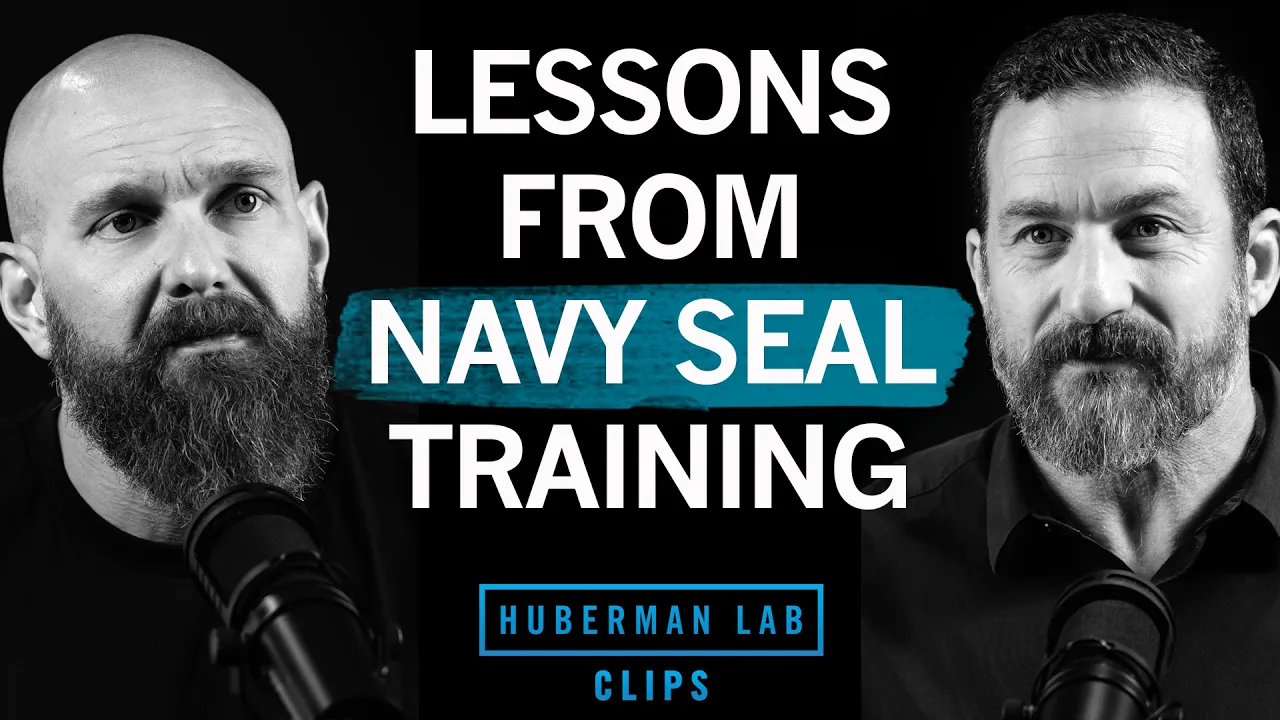
How to Build Extreme Mental Resilience | DJ Shipley & Dr. Andrew Huberman
Chapters
0:0 How Challenging is BUD/S?0:29 Pressure & Expectations
1:29 Background & Preparation
2:29 Changing Standards of Selection
3:25 Mental Resilience & Determination
4:22 Surprising Outcomes & Mental Toughness
7:49 Mindset & Perspective
Transcript
How hard was Buds relative to other things that you did in the teams? You know, I've heard people say it was the hardest thing they ever did. I've heard some people say it was extremely hard, but not nearly as difficult as, like, some aspect of, like, guys who hate the jungle and humidity are like, that was worse.
And you never know if people are joking around. I mean, did you learn a lot in Buds about yourself? If you can make it through Buds, you can do anything. It is such a brutal program, and I just, a hell week just secured, and I saw a bunch of the guys, took them out to the dinner the other night, and I was explaining to a group of civilians that were out there with them, like, their parents.
Like, you guys all see it. Every single person does that pipeline, and it's not just Buds. It's, you know, the Q course for Green Berets. It's RIP for the Rangers, MARSOC selection. Every single kid that's doing that selection program is the biggest deal in his hometown. The biggest thing in his high school.
Everybody knows he's going, and the amount of external pressure that's riding on that kid, unless you've done it, you have no idea. You just don't. It's like playing D1 college ball. Everyone in your family is expecting you to be a pro. They're expecting you to be in the NFL, and if you don't get drafted, it's like, oh, my God.
It's so much pressure on you, and it's the same way. And it's self-selection because people quit. They're not, in general, they're not asked to leave. All of that can happen. So, if somebody doesn't make it through Buds, it means they quit. Yep. Pretty much. And it's a lot of pressure, right?
The GWAT just kicking off. All the instructors were coming back from Afghanistan, and they were larger than life. I mean, you really looked up to them. And I was just very fortunate that I grew up in the culture, and I knew a lot of the guys going in. So, I knew what the end state was.
Most of these kids are from Biloxi, Mississippi. You've never even seen a Navy SEAL in real life until you showed up here. I grew up with one. All my family friends were SEALs. We didn't have a single civilian friend growing up. The only thing I've been around were commandos.
So, I felt really natural around that environment. But I knew it was going to suck. I just knew it was. Did your dad have you running with him and doing push-ups and things like that at home? No, no. Or was it mow the lawn and then go skateboarding, you know?
Mow the lawn, go skateboarding, and then as we transitioned, we got closer. It was turn it on, download the Stu Smith Guide to Navy SEAL prep, and did that like everybody else did. It's a phenomenal program for anybody who's trying to go. But I was so young. I was so immature.
Didn't have a cell phone. Didn't have a car. I lived on the barracks, and the only thing you had to do was get through the program. But what I will say is the 17-year-old me that showed up in 2002, if I would try to be a Navy SEAL in 2025, they wouldn't even take me.
My performance scores, like you have to pass a screen test, push-ups, pull-ups, run, swim, the whole thing. Your scores now have to be so competitive, they wouldn't even take me. Oh, so the standards have changed? Standards are the same, but the people going through the program are so better prepared, they wouldn't even take you.
So if you're not 120 push-ups, 120, they don't even look at you. Like for me, I basically barely scratched through. I was a strong swimmer, but technique wasn't my thing. And until you take the test, you don't realize how hard it is. And I got through it, and I went out to BUDS, and I was successful, but I was by no means a star athlete.
And you have guys, you know, Coleman Ruiz from Naval Academy. They are freaks. They're phenoms. They are professional athletes. And there you are, 6'1", 145 pounds, pot-smoking skateboarder. We are not on the same level. But mentally, you couldn't mess with me. I didn't care. Like we're getting surf tortured, and you'd watch these guys who would just see studs get up and quit.
It's not going to stop. And I feel like I always had the inside scoop. Like if you think this is going to end, it's not. Like my dad did a lot of diving. I was like I've seen the conditions they dive in breaking through the ice. Like it is only going to get worse, dude.
If this phases you, this is not the program for you. And I was right. If that phases you, the SEAL team is going to chew you alive. So not everybody should make it through that program. I was just fortunate enough that just good enough to get by, and, you know, maturity came later.
But BUDS was definitely not the hardest thing I've ever had to do. At the time, it was. And when you get through it and you see all the – I mean, you start with 200 and something people. You graduate less than 20. It's the 200 of the most physically capable people of that year in the United States Navy, and they couldn't make it.
Did any of the people that not made it through as well as made it through surprise you for not making it through or making it through? Not making it through for sure. I mean, all the guys that they – you've been around. The Captain Americas. Navy SEALs have a certain look.
They have a certain mystique, a certain – and they do in training too. It's not like you just developed that. You've had it your whole life, and there were definitely guys you look at that look like Dolph Lundgren from Rocky IV. You look at him, you're like, oh, that dude is definitely going to make it.
He's gone in 20 minutes. You're like, how? He passed everything. He didn't like that cold water. Okay. And then you see another guy who – he was worse shape than me, barely squeaked by everything, and he is the hardest dude you ever met in your life. Nothing fazes him.
Every run, every swim, just miserable. He doesn't care. He – He's kind of – it sounds like you have to not mind being miserable. You have to get used to it. You have to embrace it. It's going to suck. It's supposed to, and you just got to tell yourself it's worth the price of admission.
It's going to be miserable. You bought the ticket. You're going to get the whole show, and it's totally worth it. But you got to be there at the end. You mentioned Coleman Ruiz, who's been a guest on this podcast. He's a good friend of mine and yours as well, and you worked with him.
And I'm probably going to get this a little bit wrong, but I think once he said – because I think he was an instructor at Bud's also for a short while. I think he was. And he said, you know, when you look at the guys that make it through Bud's, nine times out of ten, they've had at least one of the following three things.
Either spent some serious time in detention in high school, played a varsity sport in high school, divorced parents. And, you know, that raises a whole bunch of other questions about, you know, friction and kind of, for lack of a better way to put it, like some internal sense of like, F you, I'm going to push through this anyway.
Or just F you to something. So when you're going – so let's assume that Coleman, having given the fact that he's not a scientist, he was a former operator, so he knows. Do you think that there were moments or many moments where it was you against them, like you and your teammates, because you're on boat crew or whatever with your teammates, you're working as a team and learning how to do that.
And it's not just about you, it's about the group, and it's about you, and it's about the expectation. But how many different bins of motivation do you have to access to get through Bud's? Is it – and is F you to the instructors or whoever, to the cold water, is that a critical bin?
It is and it isn't, because sometimes you get caught up in the moment and you don't even think about it. You just want to finish that evolution. So when you're doing a four-mile timed run, that was one of the big things. You have to do a four-mile timed run.
It's got to be, I think, a seven-minute mile or less. And nowhere in there does it say the condition of the beach matters. So if it's high tide, low tide, you have to run it on the berm and soft sand. The time standard is the time standard. And talk to anybody.
At any point in that training, you are going to hit a wall where you think your heart's going to stop. Like, if I take one more step, I'll die right here. Because your heart rate's so high. And you're like, I can't do it. And at some point, you just don't care.
You're like, I'd rather fall stone-cold dead in front of all of them and die right here than I would failing or quitting. Yeah, at least you don't have to go home head-hanging and shame. Exactly. You just push anyway. Sometimes you'll be getting surf-tortured by the instructors and you're just laying down that 60-degree water.
It's just miserable. And I tell this story quite a bit. We had dudes getting up and leaving. Mass exodus. And the biggest, strongest dudes. It's broad daylight. 70 degrees on Coronado Island. The most beautiful day you've ever seen. We're laying there just jackhammering. And you look over and all the West Coast SEAL teams are up to your right.
And you can see SEAL Team 1 out there doing log PT, feel like they're morning PT. And you can look it down to the left and you can see the Hotel Del and this little, what I call a seven-year-old, with a big pink flamingo, jumping in the water, having the best time of their life.
And I'm like, it's all about your perspective. Be a palace or a prison, however you want to see it right now. That, they're still doing it. That kid, time of their life, and we're in the exact same water. Just change your mindset. This is all part of the process.
And if you want to wear that shiny gold thing on your chest, you must do this. Just do it. And I remember that was one of the things, like, you're not going to break me. No matter what you say, I'll die right here in this water. I don't care.
And that kind of, that mindset has really been beneficial throughout the entire process. Because there's parts of, there's parts of buds and parts of being in special operations where you think it's going to kill you. And then at a certain point, you just don't care. If it kills me, it kills me.
I don't care. And you get through it. Like, you know, I'm so terrified of heights. Like, I can't jump out of the back of this airplane. You watch 15 guys go in front of you, and you get right to the ramp, and you go, I don't care. And you just, for whatever reason, they just jump.
Like, what made you jump? Everybody else did it. I didn't want to be the guy who said no. Sometimes that performance anxiety, that pressure to perform on demand, it gets you through the hump. And it shows you, there is nothing. If it can be done by a human being, I can do it.
And it just, it rings true. It's like, how far can you run? As far as I have to. Well, how fast can you run? As fast as I can. Like, if you can run that, I can run it. If you can get up and over that mountain, I can do it too.
How are you going to do it? One step at a time, brother. Here we go. And it makes you so mentally resilient. And I think that's the, that's really the defining factor is you can make them believe in their mind they can get through anything. Now, collectively as a group, now you stack 25 of those true believers together, you can do anything.
And I've seen some dudes do some Herculean feats and they do it just because they're too afraid to say no. Can you do that? Yep. You sure? If it can be done, I'll do it. I've seen it time and time again. But yeah, I mean, everybody hits those moments in Buds where it's just, I cannot believe I'm doing this right now.
But it's magic once you get through it. It's magic once you get through it. It's magic once you get through it. It's magic once you get through it. It's magic once you get through it. It's magic once you get through it. It's magic once you get through it. It's magic once you get through it.