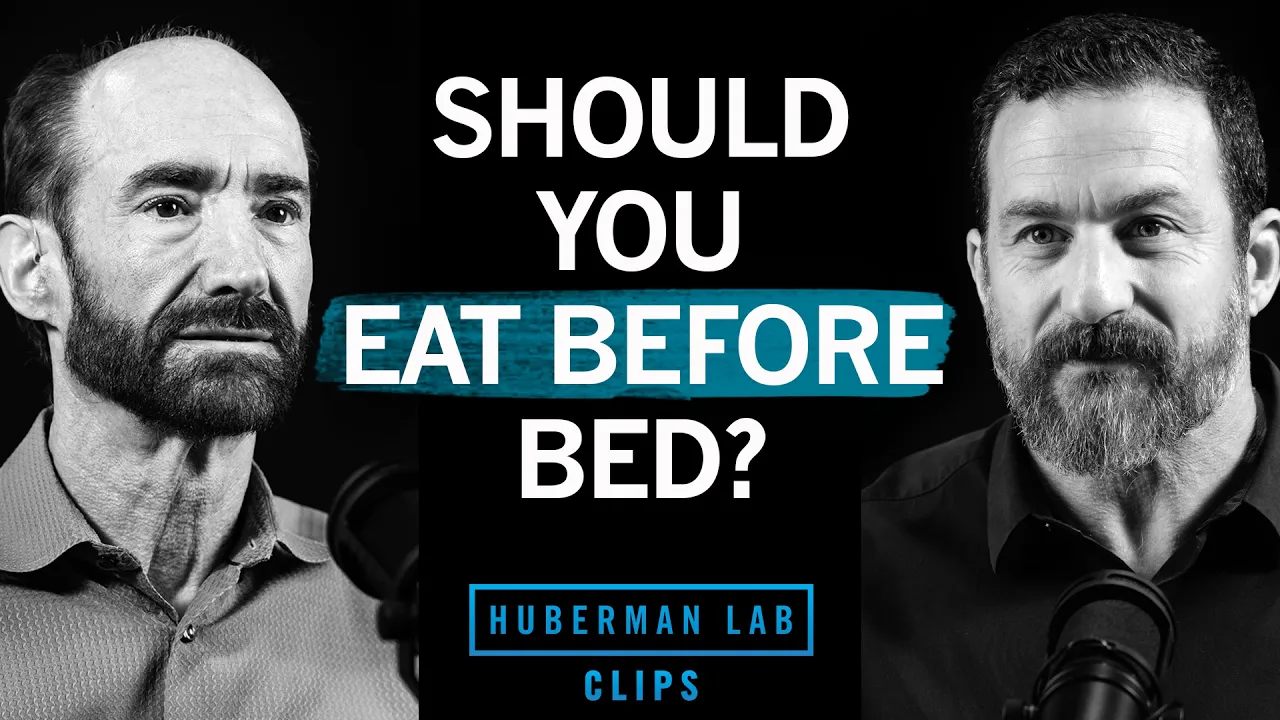
The Truth About Eating Before Bed | Dr. Michael Snyder & Dr. Andrew Huberman
Chapters
0:0 Impact of Meal Timing on Sleep & Glucose Levels2:10 Importance of Routine & Consistent Sleep
2:47 Metabolism During Sleep
4:52 Exploring Glucose Patterns & Metabolism
5:44 Microbiome & Its Role in Health
Transcript
I'd like to talk a little bit about meal timing and sleep. I do my best to eat my last bite of food at least a couple of hours before I go to sleep. Doesn't always happen. What do we know about how evening and nighttime meals impact sleep and next day glucose levels and regulation?
Well, the party line is that you should not eat three hours before sleeping. And I believe that, and that's true from the studies we've run, that people who do have a gap and actually people who walk after dinner have lower glucose the next day. And if you go into the evening with a high glucose spike, in general, that correlates with poor sleep.
So I think it's more complicated than that. I think, again, the party line will be, well, your glucose is kind of high at night and gradually goes down during the day and spike in the morning, you get a cortisol spike, as you probably know, when you wake up. And that's normal and that's healthy, helps energize you for the day.
And cortisol and glucose are related. But when you actually look at people's glucose patterns, it's much more complicated than that. And I think a lot of that has to do with what their sub-phenotype is. We don't fully understand this. We're trying to sort this out. And what you did the day, and especially the evening before, eating that big piece of pizza and then falling right asleep probably is not a great thing for you.
You will go to bed with a high glucose spike for many people. Again, unless you have perfect glucose control. So, you know, I think getting your glucose under control, it is a bit of a problem for me. We tend to eat late in my household just because both my wife and I work kind of late.
And so we tend to eat a little bit later. But I definitely do better if I can try and eat earlier. And then I definitely don't snack before bedtime, that sort of thing. And these days I try not to make my biggest meal my dinner, which again can lead you into sleep with that.
And we always take a walk. We have dogs and walk our dog after dinner. It's become a routine. You mentioned earlier about behavior. And I think the key for good behavior is to get into these routines where you can just get into that. And I think it really makes a difference.
But yeah, always, and as I'm sure you know, going to bed, people, we'd found that in some of our studies as well, going to bed the exact same time, those folks have lower glucose than those who have highly variable sleep timing. Now, that's not so great for me because I travel a fair amount.
Likewise. But I try when I'm not traveling to keep constant hours, at least that part I'm okay at. But yeah. I think we forget sometimes the number of interesting things that happen in sleep. sleep. And one of the most interesting papers, to me anyway, in the last few years was a paper that I saw where they essentially had people breathe into a tube while they were sleeping.
Okay. And evaluated the different types of metabolism that were occurring during sleep. And it turns out that as we go from light sleep to deep sleep and then more rapid eye movement during sleep as the night progresses, the brain and body transition through essentially every form of metabolism, glucose metabolism, ketogenic metabolism, a mixture of the two.
And it seems like sleep is this...we don't know if it's like a test run or if it's a reboot, or...we don't know what to call it, right? It's just very clear that during sleep, there's a lot of metabolism happening. So when you tell me that getting to bed at roughly the same time or the same time every night improves blood glucose regulation, my first thought is, "Oh, well, that makes sense because if you go to bed at the same time, then you're eating at roughly the same time, you're exercising at roughly the same time." But it could also be the case that in sleep, we're getting a tuning up of the metabolic processes for the brain and body.
Is there any evidence that supports that? Yeah. Again, I don't know from the metabolism standpoint. I like to say the things we do the most, we understand the least. Nutrition, right? How exactly does that work on all your different organs? Sleep, you know, I do like the idea of the sleep.
You would know this better than me, but your spinal fluid and such, it expands and contracts. The idea of emptying out the garbage, so to speak. Yeah, it literally rinses out your system. Yeah, and I like that concept, I think, and to what extent that is beneficial, I'm sure it is.
I don't know. And all the other facts, but even people argue what's better for your REM versus deep sleep. Even some of that is debated by experts in the field. Again, I'm not a sleep expert. I have a tendency to move into fields I know nothing about, so because I'm so naive, I hope to learn something, especially these areas that aren't so well understood.
So it's an area we're going to be studying a lot more around the glucose control. But there's no question, if you look at some people, they're spiking really bizarrely. And I have mixed days myself. I'm trying to sort that out. Somewhere I do hit the party line, higher glucose gradually go down by the morning.
But then I have nights where I'm quite irregular. And I want to correlate that with what's going on. And it's not just me. It's true of a lot of people. And I don't think that's sorted out in my mind. And I think metabolism in general, some point we can talk about the micro-sampling stuff.
But we found that we had 32 people drink this Ensure Shake while they were fasted. And they all reacted very differently to it. This is during the day now, not sleep. And for some people, it was pro-inflammatory. For others, anti-inflammatory. So interesting. I assume a lot of this got set early in life because your whole microbiome, so backing up a little bit, just so people realize that you have a lot of microbes.
You have, in fact, more microbes in you than our human cells. And they're critical for digesting your food and all this. And they heavily interact with your immune system. 70% of your immune cells are in your gut. So you have this whole interplay between your immune system and your gut.
And obviously, then the food you eat, which goes through your small intestine first, and the small molecules like glucose get absorbed. But then all the fibers, the big molecules go into your culinary, your large intestine, where they basically, you know, are interacting with these immune cells. So I think a lot, and a lot of that gets probably set early in life.
In fact, people have shown your microbiome gets set in your first three years of life. So I think that interplay all gets established and then you are reacting to some of that, your food later in life. That's at least the postulate. Not that you can't modify it. In fact, you know, switching from carnivore to veggie diets, the Mediterranean-type diets, which are sort of healthier, like fish-heavy veggie diets, I think are helpful for people.
But I do think some of this gets set early. And I think getting that set right, I think we probably need to, as a society, get that all set a lot earlier probably now too. And it's estimated, some work from Justin Sonnenberg, that, you know, native populations, these aboriginal, they have three times the number of microbes that, say, people in the US.
So we just don't have the same community that is probably handling diverse foods and probably making essential ingredients for our health that we're now missing. So we probably need to restore that in some fashion. Otherwise, this obesity and diabetes trend is just going to continue.