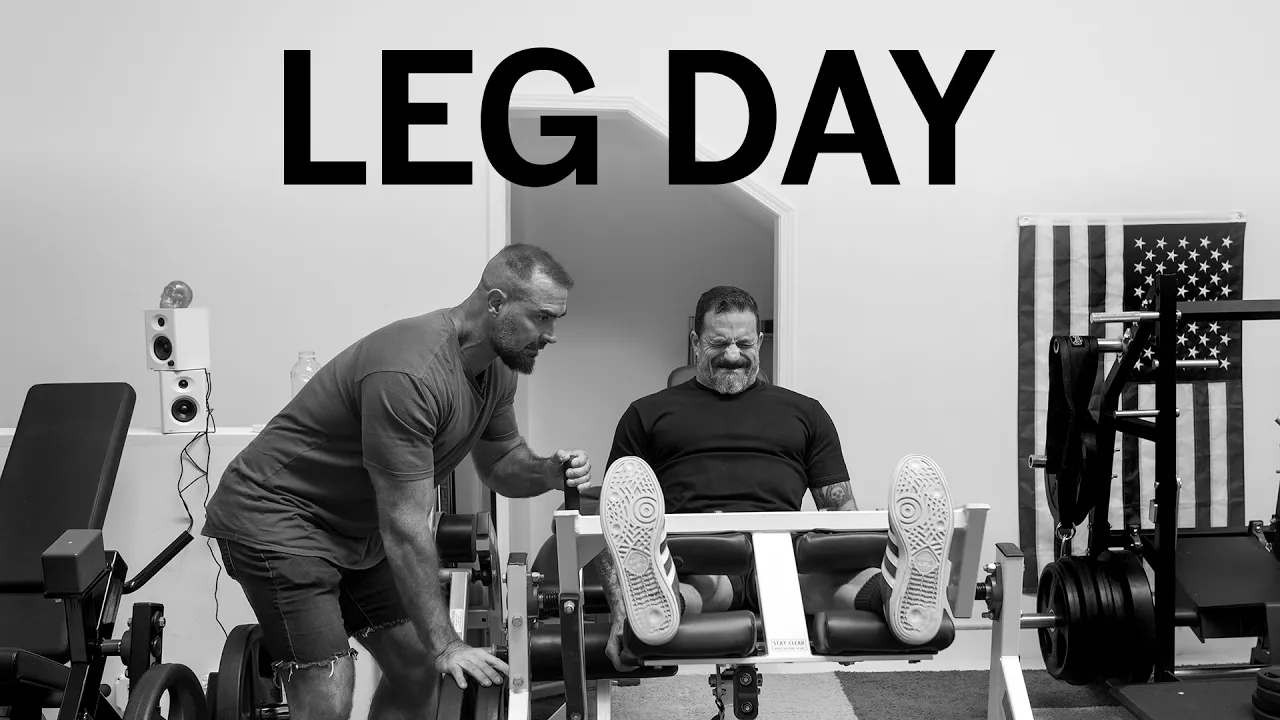
How to Build Bigger & Stronger Legs | Dr. Bret Contreras & Dr. Andrew Huberman
Chapters
0:0 Introduction to Dr. Brett Contreras0:49 Importance of Adductors & Selective Hypertrophy
3:14 Mind-Muscle Connection & Training Techniques
6:11 Leg Curl Variations & Their Benefits
7:59 Stiff Leg Deadlifts & Proper Form
10:14 Leg Extensions for Rectus Femoris
12:46 Belt Squats & Their Advantages
14:2 Adjusting Squat Technique
14:16 Experimenting with Narrow Stance
14:34 Belt Squats & Ego Lifting
15:49 Adductor Exercises
19:52 Hip Thrusts for Glute Growth
22:25 Glute Medius Focus
24:0 Conclusion & Final Thoughts
Transcript
Hey everybody, I'm here with the glute guy, Dr. Brett Contreras, who's an expert in all things resistance training. So getting stronger, hypertrophy, and these days he's best known for selective hypertrophy, how to direct muscle growth to particular muscles. And he's called the glute guy because he's developed a lot of movements and he's really the expert in how to build stronger, and if you want, bigger glutes.
So today we're going to talk about how to train your legs, everything from your calves all the way up, your quadriceps, your glutes, and your hamstrings. And adductors. And adductors, I was just reminded. Everyone forgets the adductors and today Brett will tell us why you cannot forget to train your adductors and he'll show you how to do that.
And we're also going to focus on something that everybody cares a lot about, which is how to get selective hypertrophy of muscles that, at least in your mind, you would like larger. Either because of genetics, right? You were just born with genes, let's say, gave you a shorter muscle belly of, say, your hamstrings, that would be me.
Whereas you might be glute dominant, that would also be me. Or you might have a hard time activating and growing your glutes, but your hamstrings tend to take over everything or your quads tend to take over everything. Today's discussion is also relevant if you happen to have an injury of any kind, which has had you favor certain muscle groups or created asymmetries in your body.
For instance, I would say I have a pretty decent calf on this side, but you'll notice because of an injury years ago, I have a harder time engaging this calf. So it's smaller. And as a consequence, I need to train it differently to bring it back up. Today, we're going to go through a workout that you could apply to any weak points.
So even though we're going to focus a bit on bringing up hamstrings and a particular calf in this case, for you, it might be glutes. For many people, it seems to be glutes. For you, it might be adductors. For you, it might be quads. Today's a really incredible opportunity for you to learn from the expert in resistance training, hypertrophy and strength training, how to bring up weak points or body parts that you would like larger.
So I'm really excited to do this today. You're the man. Whenever someone reaches out, which happens from time to time and says, how can I grow my glutes? I would say, well, there's literally the glute guy. He is a doctor. He's a PhD. He knows everything you need to know about how to do this.
And so I'm ready when you are. Let's do it. Am I the only person in the world that does tip raises religiously? You are, but knees over toes guy does. All right. So Andrew here is doing the tip raise. This is great for preventing shin splints and building the front muscle here, the tibialis anterior.
Hopefully your gym has one of these. This shouldn't be neglected for overall health and mainly for running, for preventing shin splints. So typically what I do, I mean, you can tell me what I should change, is I'll come in here, throw this weight on, and I'll do maybe 15 or 20 just as a warm up to get some blood in there and to really just focus on engaging the muscle.
And I never set the weight down. I'm always trying to get continuous tension. I mean, most people don't do this ever. So you start just doing it a couple of times a week, even with lighter weight, that's so much more than other people do. What's your general take on where to put your mind when you're training?
If you're a powerlifter, I think the focus should be on visualizing your deadlift while you're doing like a hip thrust, visualize your deadlift lockout, or while you're doing belt squats, pretend you have a bar on your back and visualize the actual lift you're trying to make it transfer to.
Focusing on the muscle and getting an intense mind muscle connection is invaluable. It's a necessity for lifting long-term in my opinion. Yeah. One of the reasons that I don't have mirrors in my gym is for that reason. Like I don't want to be focused on what I look like or anything.
I just want to put my mind into the muscle that I'm training. The other thing that I've noticed, and this relates directly to so-called weak body parts, is that if you can contract a muscle really hard without any weight in your hand, you stand a better chance of being able to create hypertrophy for that muscle.
So like the idea was, you know, if you can really cramp your bicep to the point where it's like, ah, that actually it not hurts, like you can go, ow, but you know, that it feels like a cramp. Then when you pick up the weight, you're trying to do that using the weight with added resistance.
And certain things like my lats, my glutes, my quads, I can flex independently and isolate very easily. Certain muscles, it's harder to do that. My delts, for instance, which have always been a lagging body part. So I think there's real truth to the mind muscle connection as it relates to during the set.
We did this in the past to grow the soleus, but the recent research is that you can grow the soleus from standing calf raises just so this is unnecessary. This is one of the main muscles that has consistently shown that a lengthened bias works better. When you reach failure with full range, you continue with partials just in the lengthened position.
Finish off with a big stretch at the bottom, hold it for like five seconds. That's where it burns like crazy. Or just do the bottom range. Would you say you broke this? I broke that left foot three times and I can't contract the gas drop. When you have a market imbalance, there's different strategies.
Do two sets for every one set. Do two sets on your left leg for every one set you do on the right leg. You can get equal muscle growth from doing low reps or high reps. In terms of the optimal number of sets per week, probably around 10 for most muscle groups.
If you really want to specialize, you can do a lot more volume, but you kind of have to take away. So this is a really key point you're making. If I'm going to, let's say, try and bring up hamstrings or calves or glutes or chest or whatever it is, and I decide to increase my volume by 50%, something else has to give.
Yeah. Instead of trying to grow everything all at once, you focus on one muscle at a time, maintain the others, and then alternate them. If you want total body hypertrophy, maybe one month you focus on chest and quads. The next month it's back and hamstrings. The next month it's glutes and adductors.
They kind of go together. In theory, it could be better. Okay. So next up, Andrew is going to do the seated leg curl. What's your favorite leg curl? Lying leg curl. I like lying leg curls too, but there's one study by Mao. He showed that seated leg curls were more effective at growing the hamstrings than lying leg curls.
Hamstrings seem to be a muscle that grows best in the stretch position. Not all of them are like that. If you're going to pick one leg curl most of the time, do seated, but with caveats. So this is one reason to maintain flexibility. Yeah, yeah, yeah. Try and get into this.
It's pretty light. So when you do seated leg curls, what you want to do is make sure right at the top here that you feel it. Some people will like touch down prematurely. You want to get all the way to the top, make sure your butt's touching the pad.
Okay. And then you could put something here like pushing you even to more hip flexion. Yeah, that's a big stretch. Yeah. Then come down. And then what I like with these, see how your butt's wanting to scoot forward. Stay. Yep. Okay. Come, come back. If Andrew's focusing on hamstrings this month, trying to really prioritize his hamstrings, then we want to use the biggest thing is to try to use progressive overload.
It doesn't have to be the most weight you've ever lived. It just means you start out. And if, if we had, we have a 45, say we had a 45 and a 25, and you can get 12, 10, 8 on that. Then the next week you get 12, 10, 10.
Then by week four, you're getting 12, 12, 12. That's progressive overload. It works well for a short stints. Then you hit a wall, but if you're always cycling around this whole premise of rotating your focus point, then it works really well that way. It's hard to emphasize to people just how, how stretched it feels.
It feels like I'm trying to reach and touch under the arches of my feet from a standing position. You're doing weighted stretching here. That feels really good. Next up, we got the stiff leg deadlift. So I'm going to have Andrew get in position. First rep will be a conventional deadlift, a normal deadlift, deadlift the weight up.
Then you organize yourself and get focused from the top. Basically put the bar at mid, like bisecting your shoe. So it's a couple inches off the shin, a little forward, a little more right there. I'd get a narrower stance. Okay. Now bend over and grab the bar. So you do three things at once.
Slightly drop the hips, arch the back, and kind of pull the armpits towards your pockets, and then keep that neck. Some people say look up because it activates the erectors more. Some people say look down. Just try to keep it fairly neutral-ish. This feels neutral, and then just drag it up.
So then your gaze will come up as you rise up, and just make sure the bar skims your legs the whole time through. It doesn't move away from your legs. Okay. I'll try and scratch them up your shins. Yep. Great. Keep the legs more straight. Focus more on a hamstring stretch.
Yes. Good. Okay. Yes. Good. Two more. Great. Don't pause at the bottom. You're making it harder. To me, the safest way, and the way that makes most sense for hypertrophy, because when you round, you're actually shutting the erectors off a little bit. You're relying on the passive structures. You still produce torque, but it's the stretching of the muscles and the ligaments and things.
The muscle activation goes down in the erectors. We're referring to spinal erectors. The spine erectors, to hold the arch, that's what they do. They erect the spine, keeping them erect. Then what you do is you train the muscles at a longer length. If you round over, you're kind of reducing the erector activation.
You reduce some of the hip flexion that you go through. Can I ask one question? If people don't have access to a bar for stiff-legged deadlifts or for Romanians, will dumbbells suffice? Okay. I like dumbbells too, because you can kind of like, you don't have to have them straight.
You can kind of have them angled a little bit. And then kind of drift a little. Yeah. Great. People love to criticize. They're going to be like, oh my good. Your deadlift form was, you don't, as a trainer, you don't pick people apart. You just always compliment. They're not going to like my deadlift form.
No, you're going to get, we're both popular. We'll get a lot of hate. But the vasties, you've got three of them, medialis, laterals, and then the intermedius underneath. Then there's this muscle, the rectus femoris. It's actually a hip flexor and a knee extensor. It's kind of like a knife-shaped muscle.
It's right here. It's the middle there. The rectum gets worked best through single joint knee extension. So these do work your vasties fine, but compound movements work the vasties better. But the compound movements do not work the rectus femoris as much. So you do leg extensions, especially for the rectus femoris, but studies show that you get more results with the rectum leaning back.
Rectus femoris looks cool when you're leaning. All the muscles look cool. So you should do leg extensions because also they don't beat you up like the compounds do. It adds more maximum recoverable volume, but also works the rectum. But when you do these, make them the best for the rectum and lean back if you can.
I go like, you know, three sets of 10 to 20. I go higher reps on these. 20 reps? 20 reps is cardio. You go so slow and everything. Try to be a little more explosive here because you're not trying to work the squeeze so much. Okay, so I'm just going to get it.
We're going to get a groove here. We'll go for like 10 reps. So don't fight it maximally. Just get in a groove. Okay? One. Okay. Okay, that was two. I'm going to pick up. Three. Four. Five. Six. I know you don't like going. Let's just do 10. That's fine.
Three more. Eight. Two more. Nine. Last one. Okay. Fight me. Good. Fight me. Good. Okay. Now hold it. Five seconds. One, two, three, four, five. Good. So when you do it that way and leaning back, some people will actually say, I felt it more in the rack fem. I actually, for the first time, actually felt it not just in here, but up in here.
I feel it here and here. Yeah. Both places. But if you felt it up higher, that's... Oh, yeah. Normally I wouldn't feel it there. I think normally I would just feel it right in the teardrop-shaped muscle. So again, you do this this way because it is the way to bias the rack fem and it's a cool-looking muscle when you get lean.
If you're training yourself and you did want to accentuate the eccentric, you could go two up, one down. We go up with two legs. Oh, yeah. Down with one leg, which this is too heavy to do. So next up, we've got the belt squat. Here's what I'll say about the belt squat.
I love to see more powerlifters using this now because it transfers well to the squat. I always noticed when I was hammering belt squats, it trains your quads in a fashion very similar to squats, but it does not beat you up. You get significantly reduced spinal loading. So you can add what I like to say penalty-free volume.
It increases your maximum recoverable volume. For quads, it is top-notch. Well, should I say for vasties, it's top-notch. It doesn't work the rectus femoris much, but here's what's cool about this. One study showed you don't get as much glute and adductor growth... You don't get as much glute and adductor growth with belt squats than you do with back squats.
With the barbell, it has you use a little more posterior chains. So this is a way to isolate the vasties a little more, but don't feel the need to go as to grasp. Yeah. You're going below parallel. I guess I do pause at the bottom. Yeah. And that makes it harder with the weight you're using.
People overemphasize, but I would say bring the feet in just a little closer. Okay. And then flare the knees out a little more as you come down so that they're tracking over the toes. So like right there. And it just feels weird at the moment because it's a new neural groove, but that's the way you teach it.
And then over time, you can stray from that. Yeah. Okay. Let's rack it. If you want to experiment a little more, let's go a little narrower stance. So this is going to be more of a quads and stay more upright. Okay. So back straight up and down. Back straighter and then let the knees jut forward.
Push with my toes. Yep. Deep, deep, deep. Yep. So everyone, when they do belt squats, it's fun to play the ego game. If I had you put it on the very last one and did you stand at the very back and sit back when you do it, it makes it so much easier.
You'd use 10 plates probably. Okay. Good. To be honest, I would rather use less weight and get more out of it. Yeah. Yeah. Yeah. I was going to say, cause then where am I going to go? Eight plates, nine plates, 10 plates. So, you know, the idea for me would be to use the least amount of weight to still feel like I'm training hard.
No. So that's this way. Like, yeah. Oh no, this is brutal. It'll stay more upright and go deep as hell. And then, but your way is also good too. You don't, you don't want all your sets to have your knees going way past the toes. Sometimes that can lead to more stress on the patella.
So sometimes, so I would say alternate between the two. How many sets and reps would you recommend? Let's say I warm up and I'm, I'm training alone and I do, and I do, um, let's say two or three really hard sets of leg extensions. So pre-exhaust and come over here and I do maybe one or two warmups to get the form right.
Yeah. I do three and three. Okay. Um, you, you could do four, but then it's like, you want to train your hamstrings too. I do think you should start doing glutes and adductors, but yeah. What would you suggest for adductors? I'll show you, we're going to do an adductor exercise, but, um, but the adductors look awesome.
That's the most slept on muscle there is with men. Um, but the thing is when you do deep, not belt squats or hack squats, as much as back squats and leg press, you can make those very hip dominant. The, the pendulum squat, the hack squat, the belt squat, these are ways to make it more knee dominant, but the, the hip dominant compound movements like leg press with your feet higher.
But even I would say even like leg press in a quad dominant fashion, look at bodybuilders. They have huge adductors. They don't do the seated hip adduction machine. They squat deep. They do. Well, I wouldn't say they barbell squat deep. They do leg press deep or sumo is the best way to work your adductors.
Plotkin 2023 compared squats to hip thrusts. And it showed that squats grew the adductors better. They grew the glutes equal, but squats grew the quads and adductors better. Neither grew the hamstrings or glute medius. So squats and hip thrusts don't grow the hamstrings or the glute medius. They grow the glutes equally well, but squats grow the quads and the adductors about two and a half times more.
If it's like, say, say 4% compared to like 10% or what about goblet squat? So if I were hip, you can make them hip dominant. So yeah, belt squats have your vasties covered. If you want adductor and glute growth. Yeah. And I think you shouldn't limit yourself and say, I'm ham.
I'm, I'm quad, glute dominant. The thing is my damn glutes grow from anything. Like, like my glutes are going to grow bigger. I'm bigger. So go down like this. Yep. And then kind of think of the seated hip adduction machine. Oh, right. Okay. You're trying to mimic that, but with body weight.
Okay. Okay. Come up, squeeze, come down, feel the stretch. Yep. Back. Come down. Yep. My rule of thumb is if someone has not done these, you don't go to failure. You just do one set because tomorrow you'll feel this for some reason, adduction and calf raises tend to get people really sore.
If you haven't done it in a while. All right. Okay. Go for it. Make it. Yep. You're trying to feel it in the stretch. So come down, come down and then squeeze. So you're sitting into it. Okay. See that. So I stretch it, squeeze it. Yep. Gotcha. These are deceptively difficult.
Yeah. We have the optimal leg routine here. If we had done a hip dominant squat, say we'd have done barbell squats. Yep. Or leg press, then we might be able to skip on the adductors. But since we did belt squat, we need an adductor movement. We don't have a seated hip adduction machine.
So we're going to try and do it with barbell. Yeah. You know, it's going to be your fault that my jeans don't fit tomorrow. All right. Okay. There we go. Now I feel it. Now I feel it. Turn out. Yep. So it's almost like you want to like kick.
Yeah. Yeah. Yeah. Good too. Okay. Yep. Ah, yeah. Don't go to failure. You'll be so sore tomorrow. Good. Now I feel it. Yeah. Okay. I'd be done. And you kind of feel yourself release here a little bit and kind of, yeah, get that stretch. Good. So this is just a Copenhagen variation.
And it's, I like having the whole shin on the bench because it it's easier on the knees. Yeah. You might feel that tomorrow. Cool. Yeah. Okay. Two more exercises. Great. Thank you. Two more. So we got, we got calves and tibialis out of the way. Yep. We got hamstrings.
We got quads. We got adductors. Now we just have glutes. Great. Okay. But my glutes are already smoked. Okay. So as a trainer, when someone learns the hip thrust, I tend to have you just get to the top position. So what does this do? This is going to work the glutes.
Okay. Now you could say what the research says about glutes is you can grow the glutes equally as effectively doing squats or hip thrusts. So if you squatted hard, the belt squat is a knee dominant squat. If you did back squats, you could have, you could have checked off glutes and hamstrings, but you didn't.
You did belt squats, which were more vasties. That's why we added in the adductor exercise. And that's why we're adding in hip thrusts. When people get back pain with hip thrusts, it's usually because they hyperextend, meaning like this. I feel that. So this might be your starting point. If you were going to start hip thrusts, I always teach people body weight first, tap down, come up, push tall, push tall with your glutes.
Okay. Come down, tap, push tall. Boom. Come down, tap, come up tall. Boom. That was a good, yes. So those last pulses are brutal. So what happens when people start hip thrusting? Good job. They're strong in a flexed position. That doesn't mean they're strong in an extended position. So I definitely feel it really well in the glute ham insertion too.
And then when you strengthen this, think about when you run. When you run, you touch down about here and then your center mass passes over the body. That running is associated with more hip neutral postures. And the research on hip thrusts versus squats for sprinting, hip thrusts appear to be superior for sprinting speed compared to squats.
The research on horizontal versus vertical plyos is the same. Well, let me ask you this. Horizontal plyos tend to be better for sprint speed than vertical plyos. And it's because there's this element of foot touching down. Like your ground contact is your window to really influence whether you accelerate, decelerate or maintain.
So when your foot touches down, you need to have that angle specific strength and power to propel you forward. I mean, it's good for function. It's good for gait. It's good for, but people will start telling me I'm, I'm taking longer strides. I feel my glutes working more when I, when I run, I think it's good for longer distances too.
Like not just sprinting, like for, it's just good to do for function. So. Well, that was awesome. Well, one more. We got a glute medius. One more. So the glute medius is on the side here. It's this strip right here, but it's actually kind of broad. So you've got like anterior, middle and posterior division to it.
I think most women should focus on the posterior division of the glute med because that will give them the shelf more. What they want though, like the, the, the, the, the shelf from the side view. What we know is that, uh, squats and hip thrusts don't build the glute medius at all.
That was shown in plotkin 2023. When you start training your hips, all the muscles in the hips, we should probably have done a hip flexion movement too. Like a single leg, straight leg sit up, for example, off of a bench with the kettlebell on the ground to work the hip flexors in a lengthened position.
You're shifting into it, feel the stretch and then shift away from it. Boom. So it's like this. And then we can put a plate right here. You can put a plate right there. Boom. Get out. Separate those legs. So shift, pop, shift, pop. Yes. That's it. Shift, pop, shift, stretch it, squeeze it.
You're trying to tilt laterally this way. And then at the top, tilt ladder that way. That's all glute med. Boom. Yep. That feels lit up here and here like nobody's business. All right. Well, Brett, thank you so much for taking me through a proper leg workout, tibs, calves, hamstrings with multiple movements, quads, glutes, and adductors and adductors.
I really appreciate the clarity of your explanations, how detailed you are, when details matter without clouding everything with excessive detail. You're focused on what works in the gym, what's worked for your clients in essentially every single client that you've posted has gotten spectacular results. And not all of them started from a genetically gifted place.
In fact, many of them didn't. And it's just spectacular to see. Obviously you walk the walk. I'm definitely feeling it from the ankles all the way up to my lower abs from what we did today. But I feel also fresh. I feel like I could certainly come back. And for me, I'm a kind of slow, slow recover.
So probably in four or five days and hit them again, I probably couldn't resist putting on a little bit more weight. But I have to say that it was really the attention to contracting the muscles of interest throughout the movement, stretching when it was needed, contracting when it was needed, that for me basically made me aware of muscles that I didn't even know that I had.
I knew they were there, but I didn't, I hadn't felt them work like I did today. So once again, thank you so much for the explanation. I feel like I've been gifted an incredible tutorial today that I'm going to carry forward for my next 50 years of resistance training.
And also everybody, you'll want to check out the full length Huberman lab podcast that I did with Dr. Brett Contreras about basically everything we talked about today and much more. There are a ton of practical tools in there. We discuss the underlying science. We talk about how to select and build a routine that's customized for your specific needs at different stages of your life, depending on whether or not you want hypertrophy, strength, a combination of both, whether or not you're trying to grow your glutes more.
After all, he is Brett Contreras, Dr. Brett Contreras, the glute guy. And if you're trying to bring up any weak or injured or asymmetric body part or body parts, that's the conversation to listen to. And as always, thanks everybody for listening in. And since he's a scientist and I'm a scientist and we're talking about training, but it's grounded in real science.
Thank you for your interest in science.